
Let’s be honest — turning an air fryer oven idea into a product sitting on retail shelves isn’t as simple as sending a drawing to a factory and waiting for containers to arrive.
For brand owners, procurement managers, and product developers new to the kitchen appliance space, the gap between “we want to launch an air fryer” and actually holding a certified, market-ready product can feel like a black box. What happens in between? How long does it take? What can go wrong — and how do you prevent it?
This article walks you through the complete development journey of an air fryer oven OEM/ODM project. From the first requirement discussion to the final mass production run, I will explain each stage, what decisions get made, what risks lurk, and how a structured process protects your brand’s investment.
Think of this as your behind-the-scenes tour of how professional air fryer manufacturing actually works — no fluff, just what you need to know to navigate your next project with confidence.
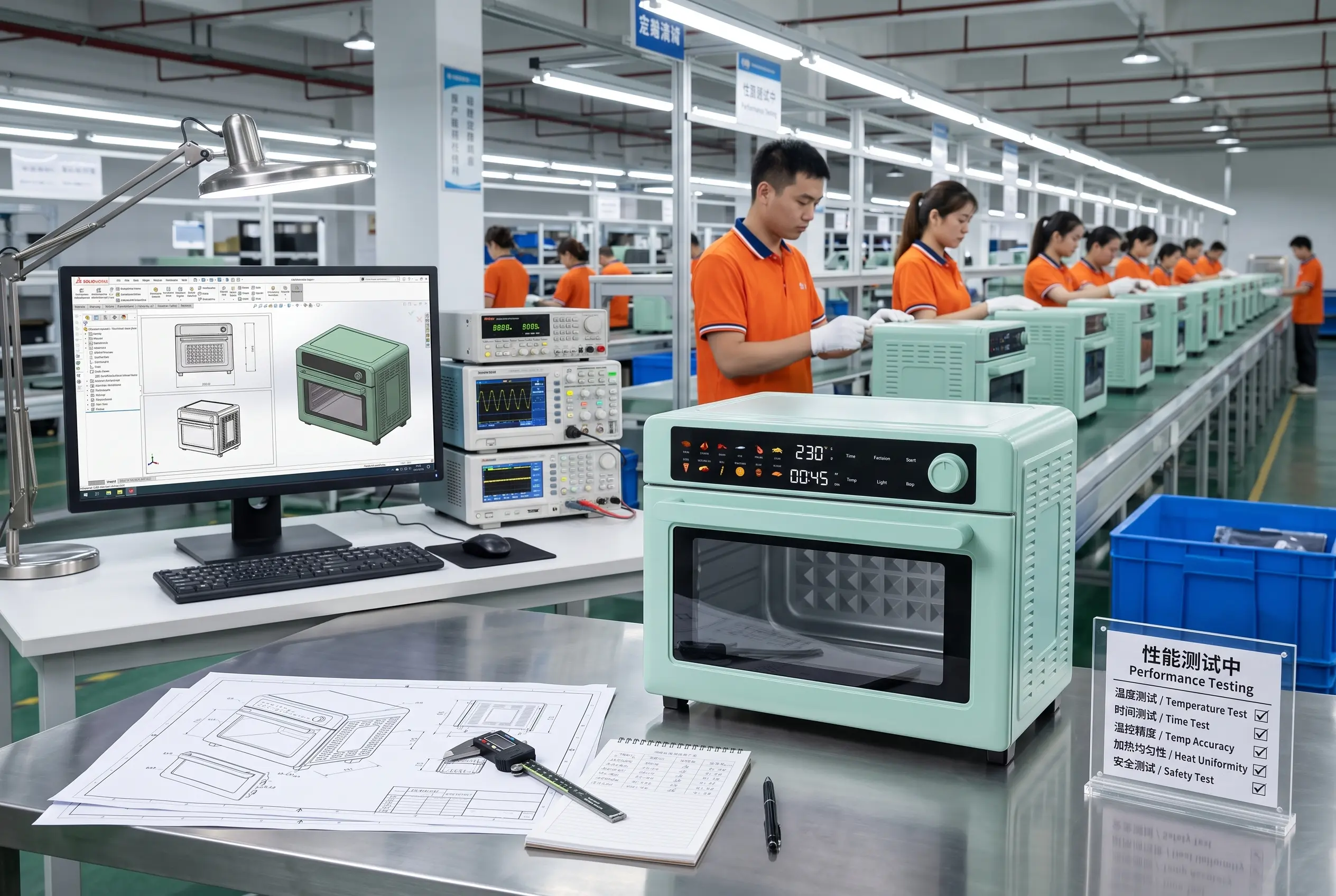
Table of Contents
1. Project Requirement Confirmation — Getting the Brief Right
Every successful air fryer oven project starts with a single, surprisingly difficult step: getting everyone on the same page about what you’re actually building.
This phase is where you translate your brand’s vision into a clear, actionable brief that the factory’s engineering team can follow. If this step is rushed or vague, everything downstream — from tooling costs to certification timelines to product performance — becomes a moving target.
What gets nailed down at this stage:
- Target market and distribution channels. Selling in North America via Walmart requires different specifications than selling in Europe through e‑commerce or in Southeast Asia through local distributors. Voltage (110V vs. 220V), plug types (US, EU, UK, AU), language on displays, and regional cooking presets all vary by market.
- Capacity and dimensions. Will it be a compact 12L model for singles and small households, a family‑sized 16L, or a large 30L for serious home cooks and commercial‑lite use? Capacity affects heating element layout, insulation requirements, and the entire bill of materials.
- Control interface preference. Mechanical knob for value positioning, digital touch for mainstream appeal, or IMD panel for premium aesthetics? Each choice carries different cost, development time, and user experience implications. We covered this decision in detail in our control system guide.
- Functions and cooking programs. Does your product need to air fry only, or also bake, roast, toast, dehydrate, and broil? Each additional function adds engineering complexity and testing requirements.
- Target retail price. This is the single most important question. Price determines which materials, components, and features are feasible. A $49.99 air fryer cannot use the same heating elements as a $199 premium model.
- Certification requirements. Will you need ETL/UL for North America, CE/GS for Europe, CB for international markets, or all of the above? Certification costs, timelines, and technical requirements differ significantly by region. For entry into regulated markets, it’s essential to ensure suppliers adhere to safety standards with documented testing.
- MOQ expectations and launch timeline. How many units in the first order? Do you need faster delivery even if per‑unit cost is slightly higher? Knowing these upfront helps your factory plan tooling, production scheduling, and component sourcing.
Common mistake at this stage: Brand owners come with a vague brief — “we want a nice air fryer” — and expect the factory to fill in all the blanks. That’s a recipe for misalignment. The best OEM partners will guide you, but you need to bring at least a clear picture of your target market, price point, and desired features.
What a good requirement confirmation looks like: A detailed document covering capacity, voltage, control type, preset menu list, color options, packaging design, certification targets, and production timeline. Some brand owners also request NDAs at this stage to protect their product concepts. While handshake deals can work with trusted partners, a real enforceable agreement that spells out IP protections, quality standards, and penalties protects both sides from expensive legal nightmares later.
2. Product Concept and Design Direction — From Brief to Visual Identity
Once the requirements are locked in, the factory’s industrial design and engineering teams begin translating those requirements into an actual product concept.
What happens in this phase:
- Industrial design (ID) exploration. Designers create initial sketches and renderings showing the product’s overall shape, proportions, and visual language. Does it look sleek and modern? Rugged and commercial? Playful and approachable?
- CMF (Color, Material, Finish) selection. Based on your brand guidelines and target market preferences, the team proposes color options, housing materials (stainless steel 430 vs. 304, ABS plastic, etc.), and surface finishes (matte, gloss, textured, or premium coatings).
- Control panel layout design. Where will the knobs, display, buttons, or touch area sit? How will the user navigate the interface? Is the text and icon size readable?
- Feature integration review. Does the door need a glass window? Should the basket have a cool‑touch handle? Where will the control board live, and how will it stay cool during operation? These decisions affect downstream engineering.
For ODM projects (where the factory designs the product and you brand it), the team often starts from an existing mature model and customizes selected features. For OEM projects (where you bring your own design), the factory takes your 3D drawings and technical specifications and begins the feasibility assessment.
Why this phase matters for your brand: The product’s appearance is the first thing customers notice on a retail shelf or e‑commerce page. A distinctive color, thoughtful CMF, and clean interface design signal quality before anyone reads a spec sheet. This is where your brand’s visual identity gets baked into the physical product.
Practical advice: Bring reference images of designs you admire — not to copy, but to communicate your aesthetic direction. “Modern minimalist” means different things to different people. A picture is worth a thousand spec words.
3. Engineering Evaluation — Where the Real Work Begins
After the concept direction is approved, engineering takes over. This is where the rubber meets the road — and where many projects succeed or fail based on the factory’s technical depth.
Key engineering activities:
- 3D structural design and technical documentation. Engineers create detailed 3D CAD models showing every component: housing, door assembly, basket, heating elements, fan system, control board housing, wiring harnesses, and venting.
- Bill of materials (BOM) development. A complete list of every component, from the heating element material (SS304 stainless steel vs. carbon steel) to the smallest screw type. The BOM becomes the foundation for costing, sourcing, and quality control.
- Heating and airflow simulation. Using computational fluid dynamics (CFD) software, engineers model how heat will circulate through the chamber. Where are the hot spots? Is the fan positioned correctly relative to the heating elements? Does the airflow reach every corner of the basket?
- Material and component specification. Which grade of stainless steel for the inner cavity? What type of non‑stick coating for the basket? Which NTC sensors for temperature monitoring? Every material choice affects cost, durability, and safety.
- Tooling feasibility assessment. Can the design be manufactured efficiently with available tooling, or does it require new molds? Are there undercuts or complex geometries that will make injection molding difficult or expensive?
At this stage, factories also consider DFX methodology — designing for manufacturing, assembly, cost, and reliability. As research from kitchen appliance engineering shows, applying DFX principles early can reduce overall product cost by approximately 10% while improving cooking performance. For example, one study re‑engineered an air‑frying microwave oven’s heating assembly by moving from symmetrical heating tubes to a rear‑mounted layout with a volute air duct, which reduced door assembly temperature and material cost while increasing the french fry cooking score from 75 to 85.
Red flags to watch for: A factory that cannot show you CFD simulation data or explain their thermal engineering approach in detail may not have the technical depth required for reliable product development.
4. Prototype and Sample Development — Seeing Is Believing
Before investing in expensive production tooling, responsible factories build functional prototypes to verify the design. This phase separates professional manufacturers from order‑takers.
The prototype process:
- CNC or 3D‑printed samples. Early prototypes for form and fit testing. These are not yet fully functional but allow you to hold the product, assess ergonomics, check assembly fit, and identify obvious issues before committing to molds.
- Engineering prototypes. Fully functional units that cook real food. These allow your team to evaluate cooking performance, temperature accuracy, user experience, and safety features. Does the air fryer actually crisp fries evenly? Does the handle stay cool during a full cycle? Do the presets match the cooking times on the packaging?
- Visual prototypes (if needed). For products where CMF and finish are critical, factories can produce visual samples that match the final production colors and materials — even if internal components are not fully functional.
- Iterative refinement. Based on your feedback, the engineering team revises the design. Maybe the basket handle needs a different angle. Maybe the presets need adjusting for local cooking habits. Maybe the door hinge needs strengthening. Each round of refinement brings the product closer to final.
What can be adjusted during this stage:
- Voltage changes for different markets (110V vs. 220V)
- Plug type adaptation (US, EU, UK, AU)
- User interface layout and labeling
- Basket and tray structure optimization
- Heating and airflow performance tuning
- Surface temperature control refinements
Critical advice: Never skip prototype testing. The cost of a few prototype units is tiny compared to the cost of discovering a design flaw after 10,000 units are sitting in a container. Cook with the prototypes in real kitchen conditions. Have different people use them. Note every annoyance, every hot spot, every confusing button. Fix those before tooling.
5. Testing and Validation — Proving the Product Is Ready
After prototypes are approved, the product enters formal testing and validation. This phase ensures the air fryer oven meets safety standards, performance claims, and durability expectations.
Types of testing:
Safety certification testing. For North America, this means ETL or UL certification. The product is tested for electrical safety, temperature rise on external surfaces, abnormal operation conditions, and component failure scenarios. As noted in our low surface temperature guide, UL 858 specifies strict limits: for surfaces less than 31 inches above ground, temperature rise cannot exceed 33°C (59°F) on metal or 51°C (92°F) on plastic. Handles during door‑opening have even tighter limits.
For Europe, CE, GS, CB, RoHS, REACH, and LFGB certifications are typical requirements. CE covers electrical safety and electromagnetic compatibility. GS is the German safety mark, often required for premium positioning. RoHS and REACH restrict hazardous substances. LFGB applies to food‑contact materials. Many suppliers serving European markets maintain all these certifications simultaneously.
Performance testing. Temperature accuracy testing (±10°C tolerance is typical), cooking uniformity testing, timer durability (minimum 10,000 on/off cycles), and surface temperature verification under worst‑case conditions.
Durability and lifecycle testing. Door hinge cycling (open and close thousands of times), button press endurance, basket and tray durability, and control board reliability under thermal stress.
Packaging and transport testing. Drop tests, vibration tests, and humidity exposure to ensure products arrive at your warehouse in sellable condition.
Regulatory compliance documentation. The factory should provide test reports for all required certifications before mass production begins. For higher‑risk categories like heating appliances, demand recent test reports or audit summaries before committing to large orders.
Why this phase matters: Certification is not optional for regulated markets. A product cannot legally be sold in North America without ETL or UL marking, nor in Europe without CE marking. Attempting to skip certification or relying on a supplier’s uncertified claims exposes your brand to recalls, fines, and liability. The factory should provide test reports from accredited third‑party laboratories.
What brand owners should ask for: Full certification documentation, including which standards were tested against and which laboratory performed the tests. Ask whether safety and EMC tests are performed internally or through accredited third parties. IEC 60335 compliance is non‑negotiable for electrical safety.
6. Pilot Run and Mass Production — The Final Transition
Once the product is fully validated, the factory prepares for production. This transition is managed through a structured pilot run before full mass production begins.
Tooling and mold manufacturing. Production molds for plastic housing components, metal cavity parts, and other injection‑molded or stamped components are manufactured. Mold precision directly affects product consistency, assembly fit, and production efficiency. This is often the most expensive single investment in the development process, which is why prototype validation before tooling is critical.
Component sourcing and supply chain setup. With the BOM finalized and tooling underway, the factory sources raw materials and components from qualified suppliers. An experienced factory does not simply buy parts at the lowest cost — it evaluates suppliers based on quality stability, certification compliance, lead time, and consistency across repeat orders.
Pilot run (small trial production). Before full production, the factory runs a limited batch (typically a few hundred units) using the exact production processes and assembly line that will be used for mass production. This pilot run reveals process issues, assembly difficulties, and quality control gaps that were not visible during prototype development.
During the pilot run, the factory’s quality team performs intensive inspections at every stage:
- IQC (Incoming Quality Control) — Verifies that raw materials and components meet specifications before they enter the production line. IQC targets problematic materials and prevents defective parts from reaching assembly.
- IPQC (In-Process Quality Control) — Monitors assembly operations in real time. IPQC performs first‑article checks whenever the line changes models or setups, conducts regular patrol inspections of critical processes, and watches for parameter drift that could cause batch defects.
- FQC (Final Quality Control) — Inspects finished units before they go into packaging. FQC verifies appearance, functional testing, key dimensions, accessory completeness, and packaging correctness using AQL sampling standards.
Process refinement. Issues identified during the pilot run are corrected before mass production. Maybe a screw‑torque specification needs adjustment. Maybe a fixture needs redesign. Maybe workers need retraining on a specific assembly step. The pilot run exists to catch these things when only a few hundred units are affected, not after thousands have been produced.
Mass production ramp-up. After pilot run approval, the factory begins full‑scale production. Quality checks continue at each stage. AQL sampling based on international standards guides finished goods inspection. Final units are packaged according to your specifications, palletized, and prepared for shipment.
For OEM buyers: Production typically takes approximately 60 days from order confirmation to shipment completion. Suppliers with response times under 8 hours and on‑time delivery rates exceeding 97% are generally considered operationally mature.
Why Structured Project Management Matters
A structured development process is not bureaucratic overhead — it is risk management.
Without clear phases, gates, and approvals, projects drift. Requirements change mid‑stream. Prototypes get approved without proper testing. Tooling is cut based on incomplete designs. And the result is expensive rework, delayed launches, or worse — a product that fails in the market.
The industry has developed mature frameworks for new product development. The Stage‑Gate process provides a conceptual and operational map for moving new product projects from idea to launch and beyond. For air fryer OEM projects, this means defined phases with formal approvals before moving to the next stage.
Common failure points in unstructured projects:
- Undefined requirement changes mid‑tooling. Adding functions after molds are cut is expensive and delays production.
- Skipped prototype validation. Going straight from concept to mass production is the fastest way to discover design flaws after thousands of units are built.
- Insufficient testing. A product that passes basic functional checks but hasn’t undergone durability or safety certification is not ready for market.
- No pilot run. The first full production batch becomes the de facto pilot run — meaning any process issues get amplified across all units.
A professional OEM partner structures development to avoid these traps. They will not let you skip steps, even when you are in a hurry. That is not inflexibility — that is protecting your investment.
How LINDEN Supports Air Fryer Oven Development
At Foshan Linden Intelligent Appliances Co., Ltd., we have developed a structured product development process that guides air fryer oven projects from initial concept through mass production. Our approach is built on three production lines serving 12L, 16L, and 30L platforms, with customers across North America, Europe, Asia, and beyond.
Our development support includes:
- Requirement alignment and feasibility assessment. We help clarify your target market, capacity, functions, and certification needs. Before any design work begins, we confirm that your project requirements are technically feasible within your budget and timeline.
- Engineering and design collaboration. For ODM projects, we offer mature platforms with customization options including CMF, control panels, accessories, and packaging. For OEM projects, our engineering team works with your CAD data to ensure manufacturability and performance.
- Prototype development and iterative refinement. We build functional prototypes for your evaluation, incorporate your feedback, and refine until the product meets your expectations.
- Certification support. Our products are certified for international markets, including ETL/UL for North America and CE/GS, CB, RoHS, REACH, LFGB for Europe and other regions. We provide full documentation for regulatory compliance.
- Quality control throughout production. We maintain IQC, IPQC, and FQC inspection systems with documented checkpoints at every stage. AQL sampling guides our finished goods inspection.
- Transparent communication. We provide regular production updates, inspection reports, and sample approvals. Our goal is to eliminate surprises and keep your launch on track.
Whether you are launching a new brand, expanding an existing product line, or developing a private label program, our team provides tailored support from concept through mass production.
Conclusion
Developing an air fryer oven from concept to mass production is a significant undertaking. It requires clear requirements, thoughtful design, rigorous engineering, thorough testing, and disciplined production management.
The process typically spans three to six months from requirement confirmation to pilot run completion, depending on complexity and whether the project uses an existing platform or requires entirely new tooling. Certification adds additional weeks depending on the target markets and standards required.
For brand owners and procurement managers, the key takeaway is this: a structured development process protects your investment. It reduces the risk of expensive rework, prevents certification failures, and ensures that when your product reaches customers, it works as promised.
The right OEM partner does not just manufacture components. They guide you through each stage, flagging risks early, validating thoroughly, and maintaining quality across every batch. That is the difference between a product launch you are proud of and one you spend months trying to fix.
Ready to develop your air fryer oven? Contact LINDEN. Tell us your target market, capacity requirements, certification needs, and desired timeline. Our engineering and production teams will guide you from concept to mass production.
