
For decades, gas was the default choice in commercial kitchens. Chefs swore by the open flame. Operators trusted the familiar roar of gas burners. But the tide is turning—and fast.
Across the globe, commercial kitchens are making the switch from gas to electric ovens. It‘s not just a trend. It’s a fundamental shift driven by rising energy costs, tightening emissions regulations, and a simple truth that’s hard to ignore: electric ovens are simply more efficient.
Here‘s why the commercial kitchen of the future runs on electricity—and why making the switch now is one of the smartest decisions you can make.
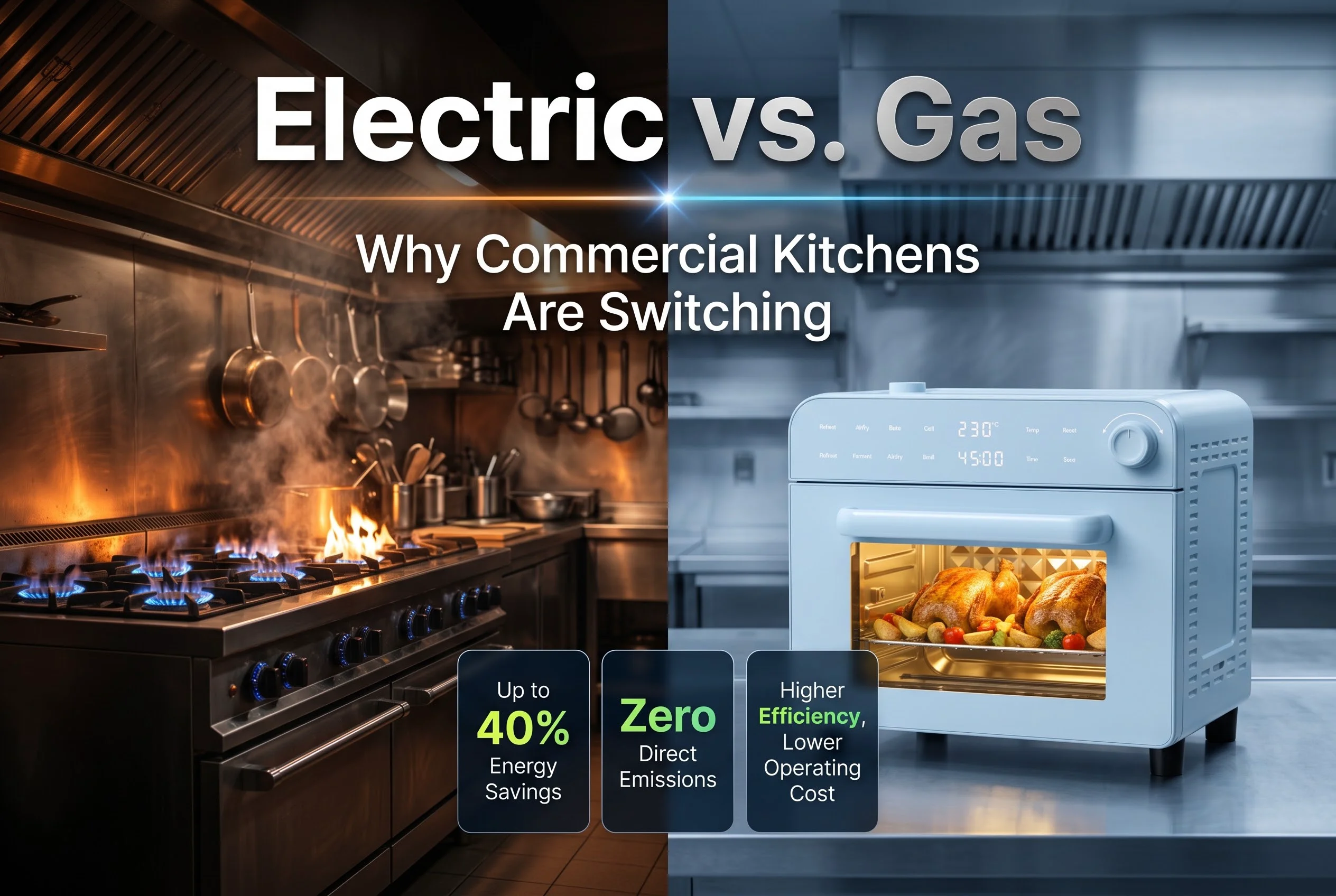
Table of Contents
The Numbers Don’t Lie: Efficiency Matters
Let‘s start with the most compelling argument: energy efficiency.
A 2025 study by a UK hospitality organization found that electric cooking equipment can reach around 90% energy-use efficiency, compared to just 40–60% for gas. That’s a staggering difference. For every unit of energy you put into an electric oven, nearly all of it goes into cooking your food. With gas, a significant portion escapes as waste heat up the flue.
ENERGY STAR data reinforces this gap. Standard electric convection ovens have a 65% cooking energy efficiency—more than double the 30% efficiency of standard gas convection ovens.
The real-world impact? A study by the Sustainable Restaurant Association, the Global Cooksafe Coalition, and Hospitality Energy Saving and Sustainability found that all-electric kitchens delivered annual energy-cost savings between GBP 2,610 and GBP 8,839, with energy-consumption cuts of 49–64% and carbon-emissions reductions of 50–65%. For a typical gastropub, the payback period was around three years, with 10-year savings exceeding GBP 65,000.
In the industrial baking sector, the numbers are equally dramatic. The new GEA E-Bake G2 electric tunnel oven—a fully electric industrial baking system—reduces energy consumption by up to 40% compared to the previous generation gas-fired model. A “net-zero” electric oven developed by Cambridge University and Ferrero Group operates at over 80% thermal efficiency—at least twice as good as traditional gas equivalents, which typically run at just 38–40% thermal efficiency.
Zero Direct Carbon Emissions: The Sustainability Edge
Energy efficiency is only half the story. The other half is emissions.
Fully electric industrial ovens now achieve zero direct CO₂ emissions. When powered by renewable electricity, the baking process produces no CO₂ emissions whatsoever.
Compare that to gas ovens, which burn fossil fuels on-site and release carbon dioxide, nitrogen oxides (NOx), and other pollutants directly into the atmosphere—and into your kitchen. Gas cooking has been shown to release indoor air pollutants like nitrogen dioxide and carbon monoxide at levels that would breach outdoor air quality standards.
Electric ovens, by contrast, produce zero direct combustion emissions. No open flames. No exhaust fumes. No direct CO₂, CO, or NOx emissions from the cooking process itself.
This isn‘t just good for the planet—it’s good for your staff. Switching to electric cuts employee exposure to harmful indoor pollutants, creating a cleaner, healthier working environment.
The Regulatory Landscape: Compliance Is Becoming Mandatory
Governments around the world are accelerating the transition—whether kitchens are ready or not.
In Australia, new residential developments must use electric cooktops and ovens from January 2026. From January 2027, the all-electric requirement extends to new large commercial buildings, offices over 1,000 square metres, and hotels. The City of Sydney adopted all-electric controls for new developments from January 2026.
In the United States, California‘s Title 24 Energy Code creates mandatory electric readiness requirements for all newly constructed commercial kitchens. Cities including San Francisco, San Jose, Santa Monica, and Berkeley have adopted gas bans for all new construction. New York’s all-electric buildings law takes effect in 2025–2028.
In China, the “gas-to-electricity” transition is well underway. Foshan has been pushing the initiative since early 2025. Nationwide, the government encourages “all-electric kitchens” for dining establishments lacking safe gas conditions. One all-electric kitchen in Hainan‘s Boao reduced carbon dioxide emissions by 7.5 tonnes per day.
These aren’t distant future scenarios. They‘re happening now. Kitchens that delay electrification risk being caught off-guard by regulations—and left behind by competitors who embrace the change early.
Beyond Efficiency: The Operational Advantages
Electric ovens don’t just save energy and cut emissions. They offer tangible operational benefits that make life easier for chefs and kitchen managers.
Superior temperature control. Electric ovens provide more accurate temperature control and more uniform heat distribution. This means consistent results, batch after batch—critical for multi-site chains and quality-focused operations.
Simpler installation. Electric ovens require no gas lines, no fuel piping, and no complex ventilation systems. Installation is faster, safer, and less expensive.
Lower maintenance. Electric equipment has fewer moving parts and doesn‘t require flues or gas safety checks, translating to lower maintenance costs over its lifetime.
Safer working environments. No open flames, no risk of gas leaks, and cooler working conditions all contribute to a safer, more comfortable kitchen.
Reduced heat in work areas. Because electric equipment wastes less energy as heat, kitchens stay cooler—a significant benefit for staff working in high-temperature environments.
The Market Is Moving—Fast
The numbers tell the story. The commercial combi ovens market is projected to grow from USD 2.04 billion in 2025 to USD 3.29 billion by 2031. Electric combi ovens already accounted for 61.23% of 2025 revenue and are projected to expand at an 8.65% CAGR through 2031.
Hybrid and fully electric systems now account for about 50% of all oven installations at leading manufacturers like Royal Kaak. Energy-efficient commercial ovens are projected to reach USD 6.8 billion by 2034.
The message is clear: the market has already voted for electric.
Addressing the Concerns
Of course, the transition isn‘t without challenges. Electric ovens often carry a higher upfront cost than gas models. And in some regions, gas remains cheaper per unit of energy.
But the total cost of ownership tells a different story. Lower maintenance costs, dramatically better efficiency, and access to green subsidies and tax advantages can offset the initial investment. Many kitchens are adopting a phased approach—replacing old gas equipment as it wears out, or electrifying the equipment where the biggest gains can be made.
The Linden Advantage: Zero Direct Carbon Emissions
This is where the shift becomes personal—and where Linden stands apart.
Linden‘s commercial ovens are 100% electric. That means zero direct carbon emissions at the point of use. No combustion. No flue gases. No open flames.
In an era of tightening emissions regulations and growing consumer demand for sustainable practices, this isn’t just a nice-to-have. It‘s a competitive differentiator. Kitchens that can demonstrate lower carbon footprints are increasingly favoured by corporate clients, institutional buyers, and eco-conscious diners.
And with energy savings of up to 40% compared to gas models, Linden’s electric ovens don‘t just help the planet—they help your bottom line.
Summarize
The shift from gas to electric in commercial kitchens isn’t a passing fad. It‘s a structural transformation driven by economics, regulation, and sustainability.
Electric ovens are more efficient—up to 90% energy-use efficiency compared to 40–60% for gas. They produce zero direct emissions. They offer better temperature control, lower maintenance, safer working conditions, and simpler installation. And they’re increasingly becoming the only option as cities and countries phase out gas in new construction.
The question isn‘t whether to switch. It’s when.
For kitchens ready to lead—not follow—the future is electric. And with Linden‘s zero-direct-carbon electric ovens, that future is already here.
