
For decades, kitchen appliance manufacturers competed on the same familiar battlegrounds: capacity, power, design, and price. But a fundamental shift is underway. Energy efficiency has emerged as a decisive competitive advantage—and the brands that recognize this are pulling ahead of those that don’t.
The numbers tell a compelling story. The global energy-efficient home appliances market was valued at $132.4 billion in 2025** and is projected to reach **$216.8 billion by 2032, growing at a CAGR of 7.3%. Within this broader category, sustainable kitchen appliances specifically accounted for $13.2 billion in 2025** and are expected to climb to **$23.5 billion by 2035. This isn’t a niche trend—it’s a mainstream market transformation.
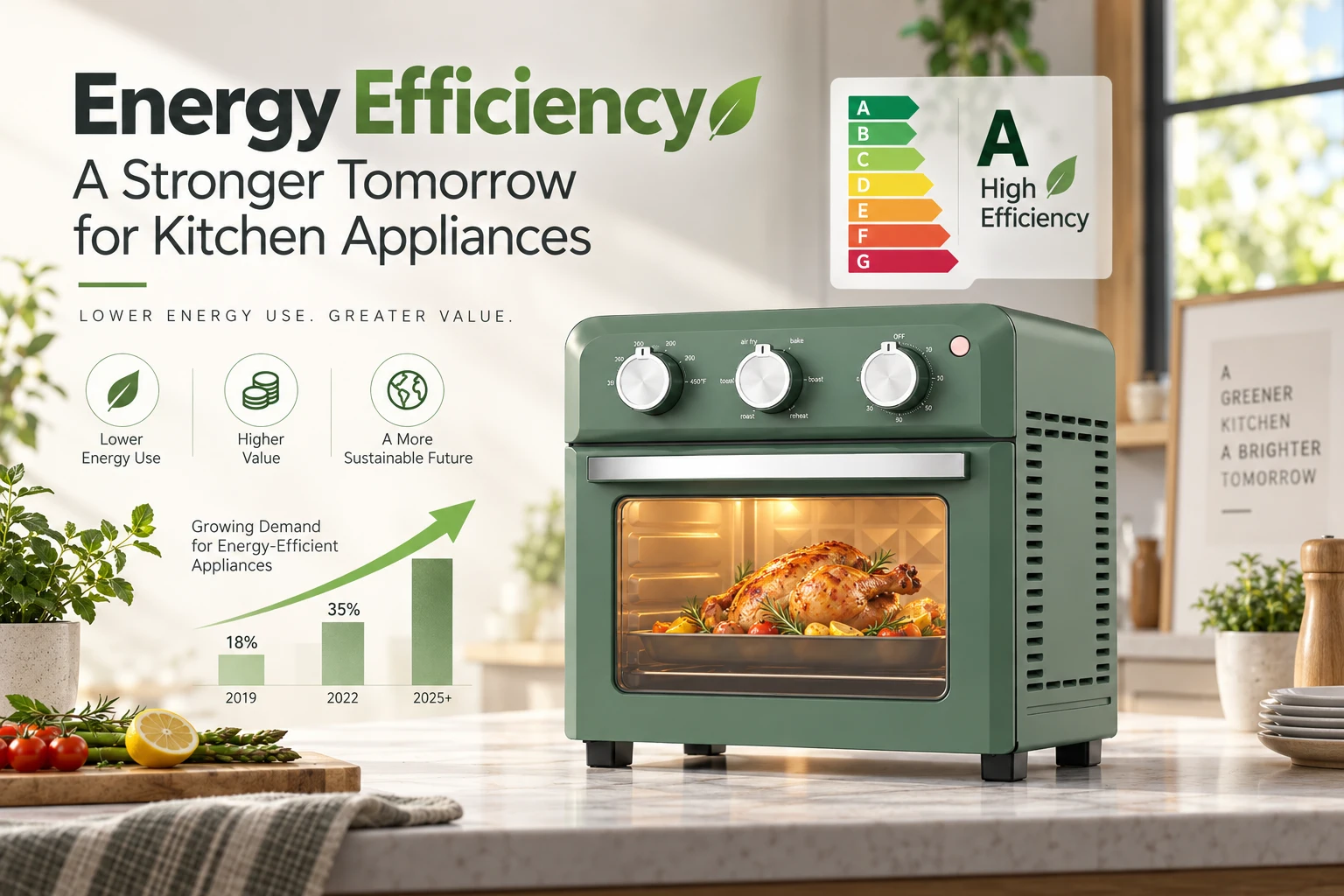
Table of Contents
The Regulatory Engine Driving Change
Governments around the world are tightening energy efficiency standards, and the kitchen appliance industry is feeling the pressure—and the opportunity.
In the European Union, new ecodesign regulations took effect in May 2025, with requirements for standby, off-mode, and network standby energy consumption. The EU has mandated that kitchen appliance standby power consumption must not exceed 0.5 watts, with a further 10% reduction in overall energy consumption targeted for 2030. The energy labeling system has also been overhauled: the old A+, A++, and A+++ classifications have been eliminated in favor of a simpler, stricter scale from G to A.
China is following suit. A new version of the Implementation Rules for Energy Efficiency Labels on Household and Similar Kitchen Appliances took effect on November 1, 2025. Leading kitchen appliance companies have already begun developing high-efficiency products and plan to complete compliance upgrades across their entire product lines by the end of 2026. Meanwhile, China’s new refrigerator energy efficiency standard—effective June 1, 2026—raises the efficiency threshold by approximately 40% compared to the previous version and introduces, for the first time, indicators for volumetric efficiency and smart connectivity.
These regulations are more than compliance hurdles—they are competitive filters. Brands that can meet—and exceed—these standards gain a clear market advantage. Those that cannot risk being left behind.
The Consumer Demand Surge
Regulation is only half the story. Consumer preferences are shifting just as dramatically.
A survey of new-construction homebuyers found that 72% of intended buyers and 65% of current owners consider energy-efficient appliances “very” or “extremely” important. Among first-time buyers, that figure jumps to 77%. As one real estate agent observed, buyers are now asking: “Do you have Energy Star appliances? Do you have anything made of recycled materials? What are the sustainability features of this?”
In North America, nearly 58% of consumers actively seek out Energy Star-rated products specifically to reduce electricity costs. And the numbers are even more striking when you look at sales trends: the share of energy-efficient appliances in total home appliance sales rose from 18% in 2019 to 35% in 2022—and the trajectory has only steepened since.
European consumers, driven by a desire to reduce energy consumption and rising environmental consciousness, are increasingly opting for eco-friendly and energy-efficient kitchen appliances. They are investing in smart refrigerators, ovens, and dishwashers that not only save energy but also adapt to user preferences.
The message is clear: energy efficiency is no longer a “nice-to-have”—it’s a purchase driver.
How Manufacturers Are Delivering
The industry’s response has been swift and innovative. Leading manufacturers are deploying a range of technologies to push energy efficiency beyond regulatory minimums.
AI-Powered Energy Management
Samsung’s Bespoke AI Dishwasher achieves Europe’s top A energy rating while delivering up to 20% additional energy savings. Its AI Energy mode can reduce refrigerator energy consumption by up to 15%. Samsung has also become the first Korean company to sign the EU’s voluntary Code of Conduct for Smart Appliances, positioning itself at the forefront of the energy-smart appliance movement.
LG’s Wide Combi Refrigerator, powered by an AI Inverter Compressor, achieves A-grade energy efficiency by adjusting cooling performance based on real-time usage. The company’s induction cooktops and built-in kitchen suites are designed to exceed Europe’s highest energy standards.
Beyond the Maximum
Some manufacturers are pushing even further. Haier’s I-Pro Shine A-70% dishwasher received German VDE certification for being 70% more energy-efficient than the EU’s highest Class A standard—making it the most energy-efficient dishwasher on the market. At IFA 2025, Haier also showcased its XYNERGY series dishwasher, which achieves an A-50% energy efficiency rating—50% less energy than the European Class A standard.
Beko has introduced PyroPro, a high-efficiency pyrolytic cleaning system that delivers a 59-minute cycle while reducing energy consumption by up to 47% compared to longer programs. Its AI AdaptiveCool technology learns user habits and environmental conditions to maintain optimal temperatures while improving energy efficiency.
Electrolux Group reports that its most energy-efficient products typically command higher profit margins. Its new AEG kitchen range can reduce the carbon footprint of the use phase by an average of 30% through features like residual heat functions for ovens.
Intelligent Sensors and Real-Time Optimization
Beyond hardware, software is playing an increasingly critical role. Midea’s ECOMASTER technology uses AI to automate energy management and proactively adjust settings across an entire suite of appliances, reducing electricity consumption by up to 30%. Beko’s HomeWhiz platform enables smart appliances to navigate energy fluctuations by activating during off-peak hours to conserve resources and reduce costs.
Bosch has introduced residual heat utilization in its Generation 7000 ovens, reducing energy consumption by up to 30% compared to other programs. AEG now offers induction hobs with glass that is up to four times more scratch-resistant, ensuring that consumers no longer have to choose between performance, design, and efficiency.
The Business Case: Why Efficiency Equals Profit
The competitive advantage of energy efficiency isn’t just theoretical—it’s showing up on balance sheets.
Electrolux Group has made sustainability central to its profitable growth strategy. By leveraging modular product architectures, the company can efficiently deliver product innovations with enhanced consumer benefits while improving margins. The company’s focus on energy-efficient products that intuitively help consumers reduce resource consumption has become a key driver of mix improvement—a term industry analysts use to describe the shift toward higher-margin, premium products.
Samsung and LG are leveraging their energy-efficiency leadership to compete directly with established European brands like Bosch and Siemens in the premium built-in kitchen segment. Energy efficiency has become a differentiator that transcends price competition.
For manufacturers, the economics are compelling. Energy-efficient products:
- Command premium pricing—consumers are willing to pay more for lower operating costs
- Build brand loyalty—satisfied customers return for future purchases
- Reduce regulatory risk—products that exceed standards are future-proofed against tightening regulations
- Open new market segments—especially in regions with high energy costs or aggressive sustainability mandates
The Road Ahead
The International Energy Agency (IEA) has made its position clear: doubling the global annual energy intensity improvement by 2030 would require appliances to become 30% to 40% more efficient. By 2030, appliances could consume 25% less energy than they do today.
The industry is responding. At major trade shows like IFA 2025 and EuroCucina 2026, energy efficiency has moved from a secondary consideration to a primary showcase feature. From AI-powered ovens that automatically select the most efficient cooking settings to dishwashers that use sensors to optimize water and energy usage in real-time, the trajectory is clear.
For kitchen appliance manufacturers, the question is no longer whether to invest in energy efficiency—it’s how quickly they can turn it into a competitive advantage. The brands that lead on efficiency will lead the market. Those that lag will find themselves competing on price alone—and in a race to the bottom, nobody wins.
