
When you look at a brand’s air fryer oven lineup, you might see five or six different models. Different sizes. Different colors. Different features. Maybe a compact one for small kitchens, a family-sized one, a premium model with a camera, and a budget version with simple dials.
But behind the scenes, smart brands don’t start from scratch for every model. They build one strong core platform and then spin it into many products. That’s platform-based product architecture. And in the crowded world of smart kitchen appliances, it’s one of the most powerful ways to grow.
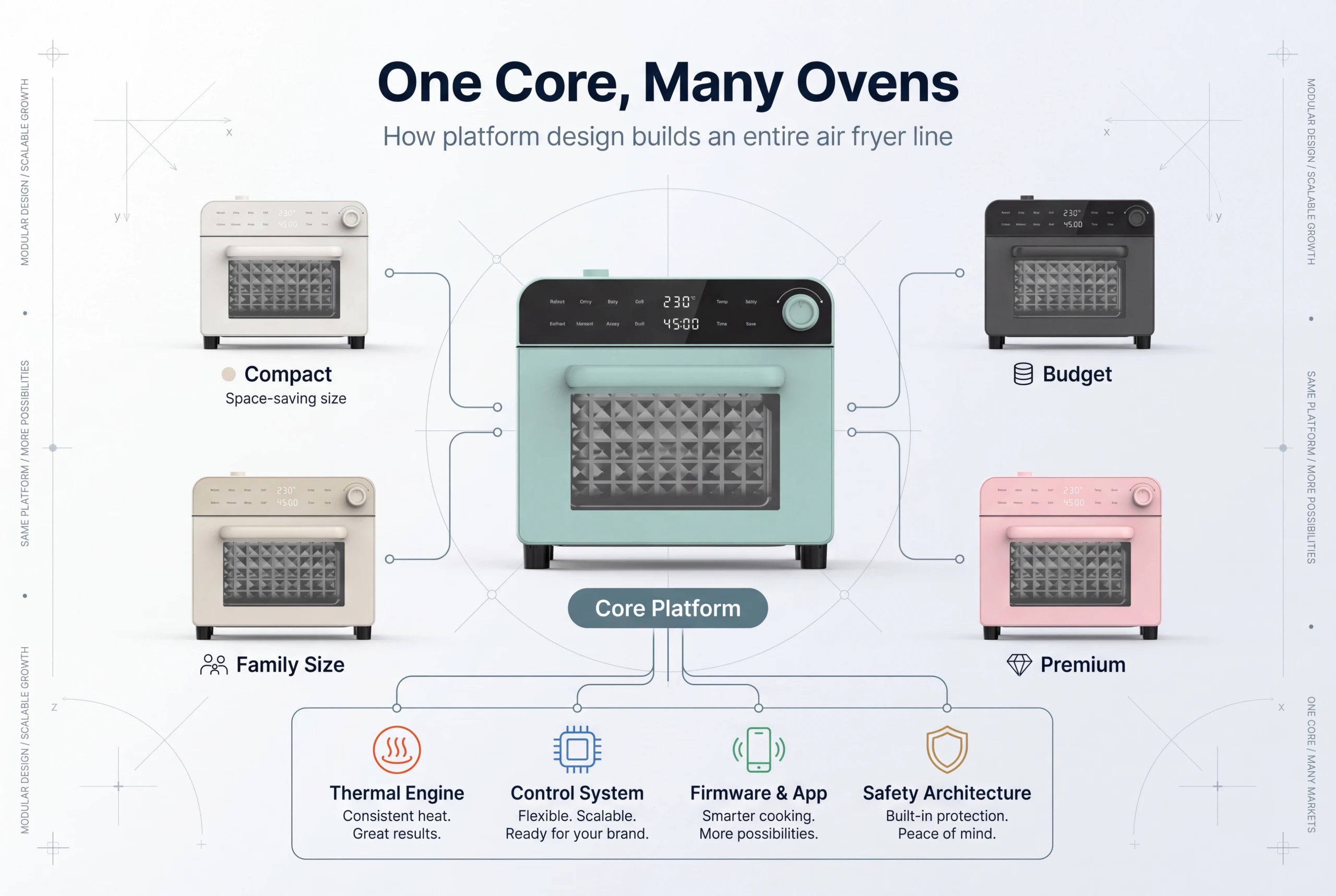
Table of Contents
What platform-based product architecture really means
Platform-based product architecture is not just reusing a few parts. It’s a deliberate strategy. You define a shared foundation—the heating system, the control system, the firmware, the app, the safety architecture—and then you build variations on top of it.
Think of it like a car platform. The chassis, engine mounts, and electrical architecture stay largely the same. But the body, interior, features, and price point can change dramatically. One platform can become a sedan, an SUV, or a pickup.
An air fryer oven platform works the same way. The core handles the hard engineering. The variants handle the market.
The core platform: the parts you don’t want to reinvent
A well-designed air fryer oven platform usually includes several shared systems:
The thermal engine. This is the heating elements, the convection fan, the airflow path, the insulation, and the temperature sensors. It’s the part that actually cooks the food. Getting it right takes time, testing, and money.
The control system. This includes the PCB, the microcontroller, the relays or TRIACs, the PID control loop, and the preset cooking algorithms. It’s the brain that keeps the cavity stable and follows temperature curves.
The firmware and app stack. This is the software that runs the presets, handles Wi-Fi or Bluetooth, supports over-the-air updates, and talks to the mobile app.
Safety and compliance. Thermal cutoffs, fuses, cool-touch surfaces, and certification for different regions. These are expensive to redesign for every SKU.
Once these core systems are proven, you don’t want to touch them unless you have to. They become the stable heart of the product line.
How one core becomes many products
From a single core platform, a brand can create a surprising amount of variety.
Capacity variants. The same heating and control system can go into a 5-liter compact oven, a 10-liter family model, or a 25-liter countertop oven. You may need to adjust wattage or fan size, but the architecture stays the same.
Form factor variants. One platform can support a single-basket air fryer, a dual-basket model, a rotisserie oven, or a toaster-oven-style air fryer. The core thermal and control design carries over.
Appearance variants. Colors, materials, handles, display types, and branding can all change without touching the core. A budget model might use a simple LED screen. A premium model might use a color touchscreen.
Feature variants. Add a food probe for precise doneness. Add a camera for visual cooking. Add a steam module for combination cooking. Add a dehydrate function or a sous-vide mode. These are modules that sit on top of the platform.
Market variants. Different voltages, plugs, and certifications for North America, Europe, and Asia. Different presets for regional dishes. Different price tiers for different retail channels.
One core. Many products. That’s the power of platform thinking.
The engineering secret: stable interfaces
The magic doesn’t happen just because you share parts. It happens because you design stable interfaces between those parts.
Mechanically, that means common mounting points, standard cavity dimensions, and consistent airflow ports. Electrically, it means shared connectors, voltage ranges, and power budgets. In software, it means a hardware abstraction layer, modular drivers, and a clean app API.
When the interfaces are stable, you can swap a module without redesigning the whole product. You can upgrade the display. You can add a camera. You can change the housing. The core doesn’t care.
This is what lets a brand move fast. A new SKU becomes a configuration exercise, not a full re-engineering project.
Why brands win with platform design
The benefits show up on the business side as much as the engineering side.
Lower development cost. Instead of paying non-recurring engineering costs for every model, you amortize the core platform across many products.
Faster time to market. A new capacity or color variant can launch in weeks instead of months. That matters in a market where trends move quickly.
Better quality and reliability. The core has already been tested, certified, and proven in the field. You’re not introducing new failure points with every launch.
Easier manufacturing. Shared tooling, shared assembly steps, and shared components mean simpler production lines and better economies of scale.
Stronger supply chain. Buying the same heater, fan, or control board in larger volumes gives you more bargaining power and better availability.
Simpler service and updates. Common parts make repairs easier. Shared firmware makes over-the-air updates more efficient.
A simple example: five models, one heart
Imagine a brand wants to launch five air fryer ovens. Instead of five separate projects, they build one core platform: an 1800-watt heating system, a high-speed convection fan, a PID control board, and a Wi-Fi-enabled firmware stack.
From there:
- A 5-liter compact model for small apartments, with a basic LED display.
- A 10-liter family model with the same core and a larger cavity.
- A 15-liter premium model with a camera, food probe, and color touchscreen.
- A dual-basket model that uses two smaller versions of the same thermal engine.
- A steam air fry combo that adds a steam module on top of the core.
Five products. One platform. Lower cost. Faster launch. Consistent quality.
Challenges to watch
Platform design is not without risks. If you standardize too much, products can start to feel the same. Customers notice when a budget model and a premium model share too much. You also need significant upfront investment before you see the payoff. Certification still has to be handled for each variant. And you have to manage internal competition between your own SKUs.
The key is balance. Share what should be shared. Differentiate what customers actually care about—size, features, design, and experience.
The future: platform plus modularity
The next step is platform plus modularity. A brand could offer a base oven and let customers add accessories or software features later. Over-the-air updates could unlock new cooking modes. Modular probes, steam trays, or cameras could be sold separately.
This turns a product line into an ecosystem. It also makes mass customization possible. A retailer could order a custom color and feature set without waiting for a full redesign.
Conclusion
Platform-based product architecture is more than an engineering shortcut. It’s a strategic advantage. By building one strong air fryer oven core—heating system, control system, firmware, and safety—a brand can launch many products with different capacities, looks, and features.
The result is lower development costs, shorter time to market, and a more consistent customer experience. In a market that keeps moving, that’s how you scale without starting over every time. One core platform. An entire product line. That’s the quiet power behind the smartest kitchen appliance brands.
