
Look, I’ll be straight with you.
I’ve spent years in this industry. I’ve watched brilliant products die on the vine because their creators couldn’t get them to market fast enough. I’ve seen brands with unlimited budgets get outmaneuvered by scrappy startups who simply moved quicker. And I’ve sat across from too many frustrated founders who asked me the same question: “Why does this take so damn long?”
Here’s the uncomfortable truth: most OEMs don’t care about your timeline. They care about their production schedule. They care about filling containers. They care about minimizing their own risk. Your urgency? That’s your problem, not theirs.
It doesn’t have to be this way. But to understand why, you need to understand what’s actually broken.
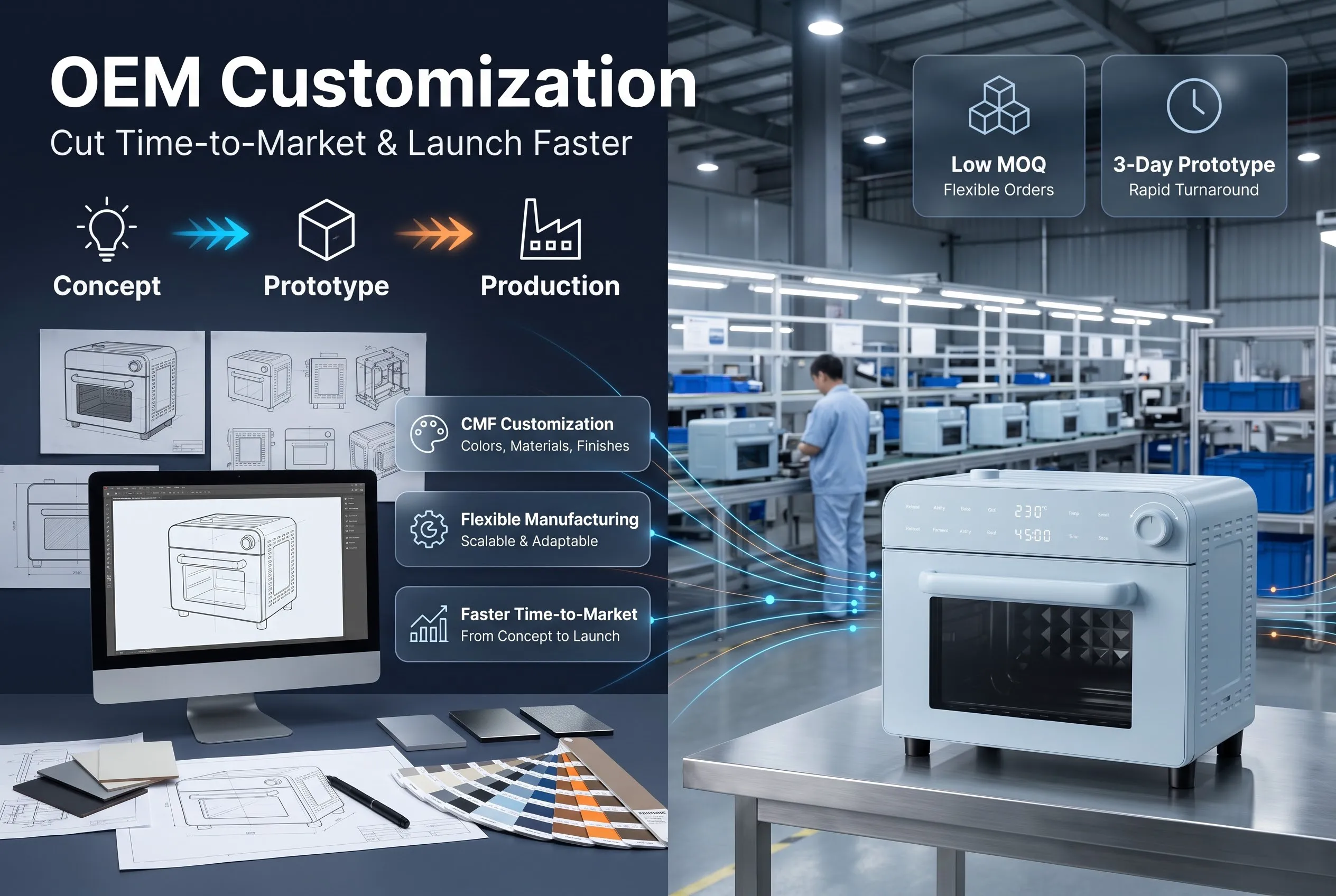
Table of Contents
The market doesn’t care about your excuses.
Air fryer ovens are everywhere right now. The global market is on track to hit $20 billion by 2030. Europe alone will push nearly three billion euros by 2028. Everyone wants in. But here’s the catch: demand is spiky. It clusters around Black Friday, around Chinese New Year, around summer grilling season, around back-to-school. These aren’t gentle waves—they’re tsunamis that rise and fall fast.
And if you miss one? You’re not just late. You’re invisible.
Retailers allocate shelf space twelve months out. Marketing campaigns are locked in. Consumer attention is fleeting. I’ve watched brands pour six figures into product development only to launch in February—when everyone’s buying swimsuits, not kitchen appliances. Their product was great. Their timing was tragic.
That’s the part nobody warns you about. You can have the best oven on the market, with the most innovative features, at the most competitive price point. And none of it matters if you show up when nobody’s buying.
The old way is a death sentence.
Let me paint you a picture of how this used to work.
You’d sketch out your design. You’d find an OEM. They’d quote you a price. Then they’d tell you: “Minimum order quantity: 5,000 units.”
Five thousand. Before you’ve even seen a working prototype. Before you’ve run a single consumer test. Before you know whether anyone actually wants what you’ve built.
So you’d scramble to raise capital. You’d borrow, beg, or self-fund. You’d place the order, cross your fingers, and pray that your marketing team could move five thousand units before the next season rolled around.
And if you got it wrong? If the color didn’t resonate? If the control panel confused users? If the finish scratched too easily? Too bad. Those five thousand units are now sitting in a warehouse, eating your cash flow, mocking your ambition.
That’s not business. That’s gambling with your entire future.
Low MOQ isn’t a favor—it’s survival.
The smart OEMs finally figured this out. Not out of generosity. Out of necessity. The old model was killing their own clients. And when clients die, suppliers lose business too.
So now you’ve got suppliers willing to run batches as small as 100 units. Sometimes even less for basic customization like logo printing or packaging changes.
Here’s why this changes everything:
You can test the market without betting your company. You can place a small order, watch what sells, listen to feedback, and iterate. And when you’ve validated your product—when you actually know there’s demand—then you scale. Not a moment sooner.
This isn’t just smart logistics. It’s psychological freedom. You can sleep at night because you’re not lying awake wondering if you just made the biggest mistake of your career.
I’ve worked with brands that used this approach to launch three product lines in the time it used to take them to launch one. They weren’t smarter than the competition. They just had a partner that let them move fast without risking everything.
Prototyping is where most projects die.
Here’s another thing nobody tells you: the prototyping phase is a graveyard of good intentions.
The traditional cycle is a monster. Concept. Design. Engineering. Tooling. First sample. Testing. Revisions. Re-tooling. Second sample. More testing. Final production. Each step adds weeks. Sometimes months. And at every point, something can go wrong and send you all the way back to the beginning.
I’ve seen projects stretch from six months to eighteen months because a single control panel didn’t feel right. Because the airflow was inconsistent. Because the color didn’t match the Pantone swatch. Tiny issues that snowballed into massive delays.
But here’s where the good OEMs separate themselves from the mediocre ones: speed of iteration.
The best partners can get you a working sample in three days. Not three weeks. Not three months. Three days. Standard samples in seven to ten. Even for fully custom work with branding changes or voltage adjustments, we’re talking fifteen to twenty days, max.
Think about what that means for your timeline.
You can test. You can fail. You can fix. You can test again. All without blowing your launch window. When prototyping takes weeks, every mistake is catastrophic. When it takes days, mistakes become tuition—you learn, you adjust, you improve.
Flexibility is the unsung hero.
Speed isn’t just about the first batch. It’s about what happens after.
Let’s say you launch. The product takes off. Demand surges. You need to scale production fast—now. Can your OEM handle it?
Let’s say the product flops. Or the market shifts. Or a competitor releases something better. You need to pivot—fast. Can your OEM pivot with you?
This is where flexible manufacturing matters. Not as a buzzword. As a lifeline.
The best OEMs design their factories to switch between small-batch custom runs and mass production without losing rhythm. They keep buffer stock of critical materials. They maintain relationships with component suppliers who are literally down the road—not on a different continent.
Guangdong province is a manufacturing ecosystem unlike anywhere else. Foshan, Zhongshan, Guangzhou—these cities are packed with suppliers who can deliver parts in hours, not weeks. You don’t need to worry about shipping containers getting stuck at the port. You don’t need to wait six weeks for a mold to be shipped from another country. Everything is right there.
Lead times drop by forty percent just from geography alone. That’s not marketing. That’s math.
CMF isn’t cosmetic—it’s identity.
Let me tell you about a brand I worked with.
They had a solid oven. Good specs. Good pricing. But it looked exactly like every other oven on the shelf. Same brushed stainless steel. Same black control panel. Same generic feel.
They couldn’t figure out why it wasn’t selling.
The answer was simple: nobody could tell it apart. In a crowded market, identical products compete on price alone. And price wars are a race to the bottom that nobody wins.
Then they got smart. They changed the finish to a premium matte black. They added a soft-touch coating on the handle. They customized the control panel layout to feel more intuitive. They matched the color to their brand palette instead of using the manufacturer’s default options.
Same oven. Completely different perception. And they could charge a premium because it felt premium.
This is what CMF—Color, Material, Finish—actually means. It’s not vanity. It’s differentiation. It’s the difference between being invisible and being unmistakable.
And here’s the part most people miss: when your OEM handles CMF in-house, you avoid the nightmare of coordinating three different vendors. One partner does the color matching, the material sourcing, the finish application, and the assembly. No finger-pointing. No communication breakdowns. No delays because the painting shop is waiting on the metal shop.
This is where we come in.
I’m not going to give you a polished sales pitch. That’s not what you need.
What I’ll tell you is this: at Linden, we’ve built our entire operation around the idea that speed and customization aren’t trade-offs. They’re the same thing.
Low MOQ? We do it because we know you need to test before you commit. Not because we’re generous—because we want you to succeed. And when you succeed, you keep coming back.
Rapid prototyping? Our engineers will work directly with your team to get samples in your hands as fast as physically possible. Not when it’s convenient for us. When you need them.
Flexible manufacturing? Five production lines. 8,000 square meters. Mold development to final assembly under one roof. When you need to pivot, we pivot with you.
CMF customization? Over thirty self-developed products. More than fifty patents. We’ve done this long enough to know what works—and what doesn’t.
We’ve been exporting to North America, Europe, Russia, the Middle East since 2021. We’re not the biggest player in the game. But we might be the most agile.
Speed is a choice.
I’ll leave you with this.
Time-to-market isn’t something that just happens. It’s something you design for. The brands that win aren’t the ones with the most money or the best marketing. They’re the ones that choose partners who understand that every day matters. Who treat your urgency as their urgency.
So ask yourself: is your OEM partner helping you move fast? Or are they the reason you’re stuck?
Because the market is waiting. The window is open—but it won’t stay that way forever.
