
Choosing the right control system is one of the most important decisions in air fryer oven development. The control panel is highly visible, frequently used, and closely connected to the customer‘s first impression of product quality. At Foshan Linden Intelligent Appliances Co., Ltd., we often discuss control panel options with brand owners, importers, and product managers during the early stage of OEM and ODM projects. A suitable control solution can improve usability, strengthen brand positioning, and support a more competitive retail strategy. A mismatched solution, however, may increase cost without creating real value for the target market.
This guide compares three common air fryer oven control solutions: Mechanical Knob Control, Digital Control, and IMD Panel. It also provides a practical framework to help you choose the best option for your product line.
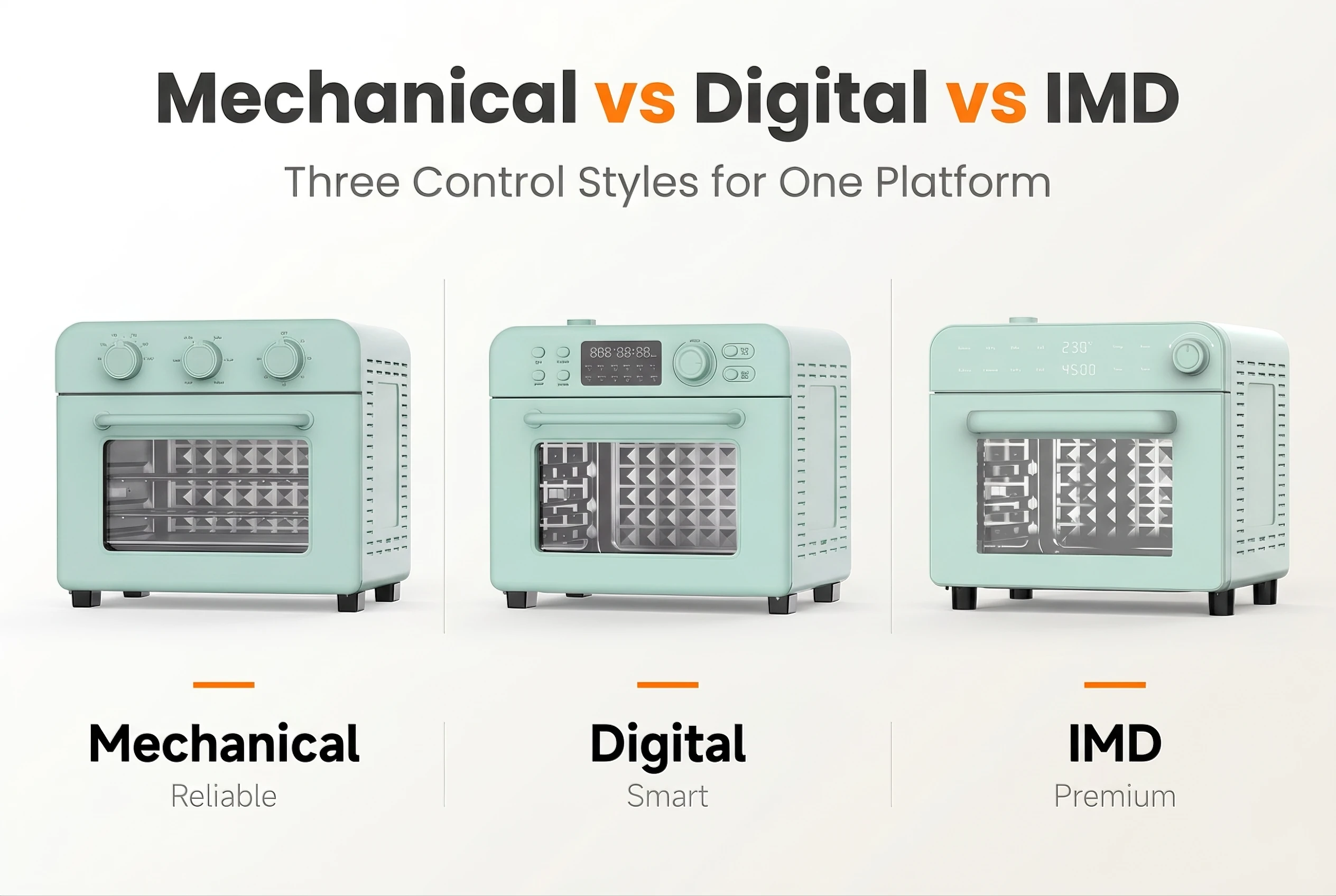
Table of Contents
Why the Control Panel Matters
The control panel is not only a functional component. It is also an important part of the product’s visual identity and user experience. For many customers, it is the first area they look at and the first part they touch.
- Usability and daily operating convenience
- Perceived quality and premium feel
- Brand identity and product differentiation
- Retail price positioning and target market fit
- Development cost, tooling complexity, and manufacturing efficiency
For air fryer ovens, the best control system should match the product‘s capacity, function menu, price range, market positioning, and customer preferences. Beyond these basics, the control panel serves as the primary touchpoint between the user and the appliance—it defines the entire cooking journey. A well-designed interface reduces cognitive load, minimizes errors, and creates positive emotional associations that drive repeat purchases and brand loyalty.
The Control Panel as Brand Identity
When a customer walks down a retail aisle or scrolls through an e-commerce site, the control panel is often the first differentiator they notice. A mechanical knob signals “classic and reliable.” A sleek digital interface says “modern and precise.” An IMD panel whispers “premium and sophisticated.” Each communicates a distinct brand promise before a single meal is cooked. This means your choice of control system isn‘t just a technical decision—it’s a strategic branding decision that shapes how consumers perceive your entire product line. Think of it as the “face” of your appliance: it needs to smile in the right way for your target audience.
The Four Layers of User Experience in Control Panel Design
In user experience design, Don Norman‘s concept of visceral, behavioral, and reflective levels helps explain why control panels matter so much. The visceral level is the immediate emotional reaction—does it look attractive and feel satisfying to touch? The behavioral level is about usability—can users operate it intuitively without reading a manual? The reflective level is the story users tell themselves afterward—“I feel like a tech-savvy home chef” or “This reminds me of my grandmother’s kitchen.” Your control panel design influences all three layers simultaneously. A knob provides satisfying tactile feedback (visceral), simple operation (behavioral), and nostalgic warmth (reflective). A touchscreen offers a modern aesthetic (visceral), advanced presets (behavioral), and a sense of being “cutting-edge” (reflective). The IMD panel delivers seamless integration (visceral), effortless cleaning (behavioral), and a feeling of owning something truly premium (reflective). Understanding these layers helps you match the control system to the emotional journey you want your customers to experience.
1. Mechanical Knob Control
Mechanical knob control remains a popular and practical solution for many air fryer oven models. It is simple, intuitive, and familiar to a wide range of users.
Key Advantages
- Easy operation with a low learning curve
- Lower development cost and shorter project timeline
- Reliable structure and easy maintenance
- Clear cost-performance advantage for value-oriented products
- Suitable for classic product styling and traditional retail channels
- High durability with fewer electronic components that can fail
- Satisfying tactile and auditory feedback (the “click” of a detent)
- Ideal for users with limited digital literacy, including elderly consumers
Best for
Mechanical knob control is a strong choice for entry-level and value-segment air fryer ovens, especially when the target market is price-sensitive or when customers prefer straightforward operation. It‘s also particularly suited for commercial kitchens and high-volume food service environments where reliability trumps complexity, and for brands targeting older demographics who may find digital interfaces intimidating.
Consider Before Choosing
This solution may not fully support a premium technology image or complex preset menus. If your product requires many automatic cooking programs, a digital or IMD solution may be more suitable. Additionally, mechanical knobs typically offer limited precision in temperature and time settings compared to digital alternatives—usually in fixed increments rather than single-degree adjustments. When designing the layout, consider knob spacing, grip ergonomics (textured vs. smooth surfaces), and the placement of indicator markings for optimal readability.
2. Digital Control Panel
Digital control systems usually include buttons, touch keys, LED displays, or LCD screens. Compared with mechanical knobs, digital controls offer more precise settings and a more modern user interface.
Key Advantages
- Accurate time and temperature control
- Support for multiple functions and preset menus
- Modern appearance suitable for mainstream products
- Better flexibility for user interface and menu customization
- Easier platform upgrade for future smart or advanced functions
- Can incorporate smart connectivity (Wi-Fi/Bluetooth) for app control and recipe updates
- Visual feedback through backlit displays enhances usability in low-light conditions
- Allows firmware updates to add new features post-launch
- Integration with voice assistants (Alexa, Google Home) for hands-free operation
Best for
Digital control is ideal for mainstream family air fryer ovens. It offers a balanced combination of usability, features, cost, and visual appeal, making it suitable for many retail and e-commerce product lines. It‘s the go-to choice for brands targeting millennial and Gen Z consumers who expect smart functionality and seamless digital experiences. The global digital air fryer oven market reached approximately 10.5 billion RMB (around $1.45 billion USD) in 2025 and is projected to hit 14.74 billion RMB (around $2.03 billion USD) by 2032, growing at a CAGR of 5.0%. This growth trajectory signals that digital controls are not just a trend—they’re becoming the industry standard.
Consider Before Choosing
Digital panels require more attention to interface layout, icon clarity, button logic, display brightness, and software menu structure. A small screen must be designed carefully to keep information readable and easy to operate. Additionally, digital interfaces can be less responsive when users have wet or greasy fingers—a common scenario in real kitchen environments. This is where capacitive touch technologies offer improvements over traditional membrane switches, but they also come with higher costs. From a reliability perspective, digital control boards can fail suddenly rather than wearing down gradually like mechanical knobs. If a control board or touch panel fails, the entire appliance may become non-functional, making quality assurance and component selection critical.
Emerging Trend: TFT Knob Screens
A noteworthy innovation in digital controls is the TFT knob screen—a physical knob with an embedded TFT display that changes contextually. The Red Dot Award-winning Intelligent Double-Cavity Air Fryer Interface uses exactly this approach, replacing text-heavy layouts with a simplified, multi-functional system that presents only essential information at each step. Multi-sensory feedback—lights, color shifts, sound, and haptics—enhances user engagement. This hybrid solution bridges the gap between the tactile satisfaction of knobs and the contextual intelligence of digital screens, representing the next frontier in air fryer UX design.
3. IMD Panel
IMD, or In-Mold Decoration, is a premium control panel solution often used when the product requires a clean, integrated, and high-end front appearance. It combines functional control with a refined surface design.
Key Advantages
- Seamless integration with the overall product design
- Clean and elegant front face with strong shelf appeal
- Durable surface with good scratch resistance
- Easy-to-clean appearance suitable for kitchen appliances
- Strong support for premium lifestyle brand positioning
- Eliminates post-processing and reduces assembly steps, lowering total manufacturing costs at scale
- Creates a waterproof, dustproof, chemical-resistant sealed surface—ideal for kitchen environments
- Allows intricate patterns, textures, and backlighting effects that are impossible with traditional decals or printing
- The decorative layer is permanently bonded behind the protective plastic layer, preventing peeling or fading over time
The IMD Advantage: Beauty That Lasts
Unlike traditional labels or printed overlays that can peel, scratch, or fade over time, IMD integrates the graphic layer behind a protective plastic film during the injection molding process. This means your brand’s icons, indicators, and decorative elements are permanently sealed and virtually indestructible under normal kitchen use.
Best for
IMD panels are especially suitable for premium product lines, lifestyle appliance brands, and projects that require stronger market differentiation. They help the air fryer oven look more modern, minimalist, and valuable. For brands competing in crowded retail spaces where visual differentiation is paramount, IMD creates a distinct “halo effect”—customers perceive the entire product as higher quality based on the seamless, integrated appearance of the control interface.
Consider Before Choosing
IMD solutions usually require more careful design coordination, including panel artwork, color matching, touch area layout, indicator visibility, and CMF consistency. They are best used when the product’s target price and brand positioning can support a premium appearance. Additionally, IMD requires higher upfront tooling investment and longer lead times for mold development. However, once the tooling is established, IMD can actually lower per-unit costs at scale by eliminating secondary decoration processes. For brands planning substantial production volumes, the ROI often justifies the initial investment.
Control System Comparison for Air Fryer Ovens
| Dimension | Mechanical Knob | Digital Control | IMD Panel |
|---|---|---|---|
| Cost Level | Low | Medium | Medium to High |
| User Experience | Simple, direct, familiar with tactile feedback | Precise, multifunctional, modern with visual feedback | Clean, integrated, premium with seamless surface |
| Appearance | Classic and practical | Modern technology feel | Minimalist and high-end |
| Functionality | Basic time and temperature control | Preset menus, timer, temperature, display feedback, smart connectivity ready | Touch control, integrated graphics, premium interface |
| Durability | High — fewer electronic components | Moderate — depends on component quality | High — sealed, scratch-resistant surface |
| Development Complexity | Relatively low | Medium | Higher design and integration requirements |
| Recommended Positioning | Entry-level / value segment | Mainstream / family segment | Premium / lifestyle segment |
| Target User | Price-sensitive, elderly, commercial kitchens | Tech-savvy, families, e-commerce shoppers | Design-conscious, premium brand aspirants |
How to Choose the Right Control Solution
A practical way to choose the right control system is to start from market positioning instead of only looking at the panel itself.
| Product Positioning | Recommended Control System | Reason |
|---|---|---|
| Entry-level / Value segment | Mechanical Knob Control | Lower cost, easy operation, strong cost-performance ratio |
| Mainstream / Family segment | Digital Control | Balanced functions, modern operation, suitable for presets and daily cooking |
| Premium / Lifestyle segment | IMD Panel | Integrated appearance, high-end feel, stronger shelf appeal and differentiation |
Many brands also use the same capacity platform with different control systems. For example, a 16L or 22L air fryer oven can be developed in a mechanical knob version, a digital version, and a premium IMD version. This strategy helps brands cover different price tiers while keeping the core product platform efficient. This is the essence of platform-based product architecture—deriving multiple market-facing variations from a single engineering foundation to maximize R&D ROI and minimize time-to-market for each tier.
Step-by-Step Decision Framework
When evaluating control options, consider the following criteria in priority order:
- Target Retail Price: This is the single most important filter. Mechanical knobs dominate sub-$50. Digital controls shine from $50-$120. IMD becomes economically viable above $120.
- Primary Sales Channel: Retail shelves demand strong shelf appeal (IMD or sleek digital). E-commerce prioritizes feature listings (digital with presets). Discount channels favor knobs.
- Target Demographic: Elderly users prefer large knobs. Young professionals expect touch interfaces. Family cooks appreciate presets. Commercial kitchens need durability above all.
- Product Complexity: Basic 1-2 function air fryers work fine with knobs. Multi-function ovens (air fry + bake + roast + dehydrate) require digital or IMD to avoid user confusion.
- Regional Market Preferences: Asian markets show higher preference for digital/touch controls, while European and North American value segments still favor knobs. South American markets are price-sensitive, making knobs dominant.
LINDEN‘s Control Panel Customization Support
At Foshan Linden Intelligent Appliances Co., Ltd., we provide flexible customization support for air fryer oven control systems. Our team can help you evaluate product positioning, control logic, UI design, appearance integration, and production feasibility.
- Flexible mechanical knob layout and appearance design, including custom knob profiles, grip textures, and color matching
- Custom digital interface, icon layout, and menu logic development with support for multi-language and regional compliance
- Professional IMD panel artwork, touch area layout, and integration support for seamless front-face designs
- Color matching and CMF (Color, Material, Finish) coordination for the whole product appearance
- Function menu and preset program customization based on target market needs and local culinary preferences
- OEM/ODM support for different capacity platforms and product series
- Firmware customization and OTA update capability for connected appliances
- Capacitive touch sensitivity tuning for wet/dry hand conditions
Beyond individual panel designs, LINDEN offers comprehensive CMF (Color, Material, Finish) coordination, ensuring that the control panel harmonizes seamlessly with the product body, handle, and trim elements. For brands seeking to reinforce their visual identity across multiple SKUs, we can develop a family design language—a consistent control interface signature—that carries through entry-level, mid-range, and premium models, building cumulative brand recognition with every product sold.
Conclusion
The control system plays a decisive role in the success of an air fryer oven. Mechanical knob control is practical and cost-effective. Digital control offers a strong balance between function and modern appearance. IMD panel design helps create a premium, integrated, and lifestyle-oriented product image.
The best choice is not always the most expensive solution. The right choice is the one that matches your brand positioning, target retail price, function requirements, and customer expectations.
Need help choosing or designing the right control panel for your air fryer oven project? Contact LINDEN and share your target market, capacity requirement, price range, and preferred control style. Our team will provide a tailored recommendation and technical support for your project.
