
Let’s be real: a hot handle isn’t just annoying – it’s a lawsuit waiting to happen.
When brand owners and product managers shop for an air fryer oven, they usually talk about size, looks, features, and price. But there’s one thing that gets ignored until it’s too late: low surface temperature.
This isn’t some nerdy engineering checkbox. It affects how safe the product feels when you use it, how confident your customers are, how many complaints you get, and whether people think your brand is cheap or premium.
For OEM and ODM projects, keeping the outside cool isn’t as simple as turning down the heat. It takes smart design, insulation, airflow tricks, door engineering, and a lot of testing. This article explains what low surface temperature means, why it matters, and how real engineering can help you get it right.
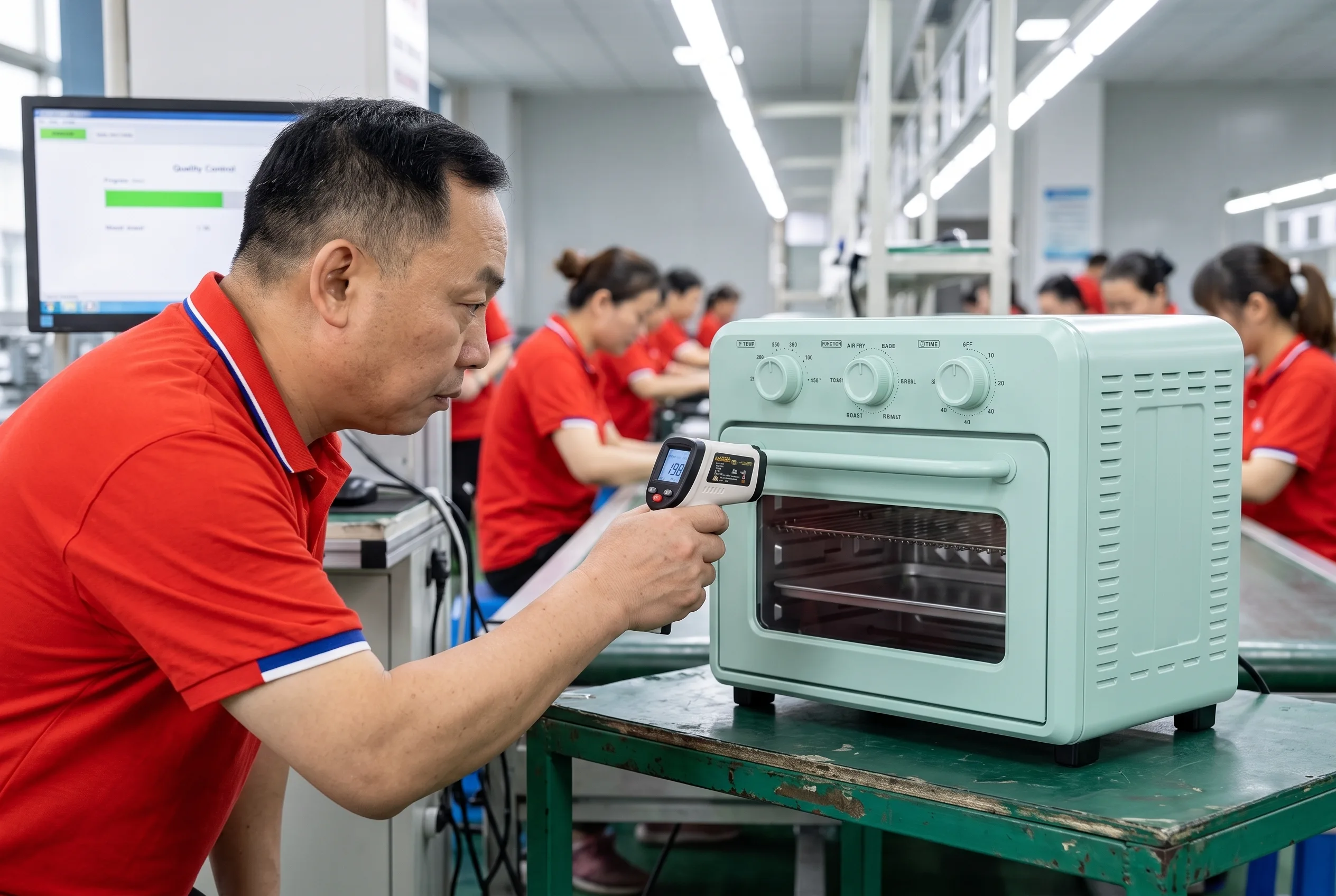
Table of Contents
What Is Low Surface Temp?
It means controlling heat on the outside of the oven while it’s running. The inside might be screaming hot – up to 450°F / 230°C – but the parts people actually touch (top, sides, handle, front frame, control panel, buttons, glass door) should stay safe and comfortable.
The goal is simple: keep heat inside where it belongs, without hurting cooking performance. A good design cooks like crazy inside but stays cool to the touch outside.
Why Customers Care?
Modern buyers want kitchen gear that’s powerful, good-looking, and safe. That’s especially true for families with kids, older folks, and open-plan kitchens where the oven sits right next to where people hang out.
Here’s what better surface temperature gives your end users:
- Fewer accidental burns during everyday cooking
- More confidence when touching handles, doors, and buttons
- Better fit for family kitchens and tight spaces
- A “premium” feel that says thoughtful engineering
- Fewer one-star reviews about “getting too hot”
For most people, safety isn’t about passing a lab test. It’s about how the product feels when they use it. If the handle burns their hand or the top is too hot to touch, you’ve lost them. They’re not reading a spec sheet – they’re reacting to a physical sensation.
The Hidden Cost of “Good Enough”
What does a hot handle really cost your brand? Let me count the ways:
- Reviews – “The outside gets dangerously hot” is a one-star review that never dies.
- Returns – Burn complaints mean returned products, which eats your margins.
- Liability – One serious burn can trigger lawsuits and government nose-poking.
- Retail relationships – Stores track return rates. High thermal complaints = lose shelf space.
- Brand perception – People equate “hot on the outside” with “cheaply made.”
Why Low Surface Temp Is Hard to Do
Air fryer ovens are tiny boxes that pack extreme heat, strong fans, multiple heating elements, a glass door, and electronics into a very small space. That’s a real engineering headache.
Common problems:
- High internal heat + limited room for insulation
- Heat leaking from elements and cavity to the outer shell
- Poor airflow design that doesn’t cool effectively
- Having to balance safety with cooking speed, energy use, and size
- Heat messing with the door frame, glass, control panel, and electronics
Some factories try to fix this by just lowering the power – but that kills cooking performance. A real solution balances safety, cooking efficiency, energy use, and cost through complete thermal design from the ground up.
Real Stakes: Burn Injuries Are Not Theory
Let’s talk about what happens when surface temp design fails. This isn’t hypothetical – it’s happening right now.
In September 2025, the US Consumer Product Safety Commission recalled over 1.3 million Oster French Door Countertop Ovens. The problem? Doors could close unexpectedly, causing burns. Sunbeam got 95 burn reports, including two second-degree burns that needed medical care. Those ovens were sold at Costco, Amazon, Walmart, Bed Bath & Beyond from 2015 to 2025, priced $140–$250.
This isn’t a one-off. A 2020 report from the National Fire Protection Association says most cooking-equipment burns come from touching a hot object, not fire – and ovens are the biggest culprit. Kids are at much higher risk: only 6% of the population but a scary share of non-fire burn injuries.
This is why standards like UL 858 set strict surface temperature limits. For surfaces lower than 31 inches off the ground, temperature rise can’t exceed 33°C (59°F) on bare/painted metal, or 51°C (92°F) on plastic.
These aren’t just red tape – they save people from serious injury and protect your brand from devastating recalls.
6 Key Design Factors That Affect Surface Temp
Getting low surface temperature right depends on the whole product working together. Here are the six most important pieces.
1. Housing Structure & Material
Double-wall construction, heat-resistant plastics or metal, and good separation between the inner chamber and outer shell make a huge difference. Pick materials that resist heat and last.
What to look for: High-end air fryers use double-layer stainless steel or insulation between walls. Stainless steel doesn’t transfer heat well naturally, and a multi-layer design stops heat from leaking out.
If the outer casing is poorly designed, surface temps can get dangerous. International safety standards limit casing temps during use. That’s why good designers use a double-layer structure – an air gap between inner and outer walls.
2. Internal Insulation Layers
Insulation has to go in exactly the right spots around high-heat zones. Too little and surfaces get hot. Poor placement can block airflow or cook your electronics.
Emerging material: Aerogel insulation is showing up in premium appliances. It’s 90% less conductive than fiberglass and can cut heat loss by 50%. Some new patents describe insulation layers using glass-fiber silica aerogel between inner and outer walls – aerospace stuff now in your kitchen.
One patent describes an air fryer with a heat insulation component that forms a chamber filled with insulation medium. Goal: reduce how much cavity heat hits external electronics and keep body surface temps low.
3. Air Duct & Cooling Airflow
A smart airflow path pulls heat away from critical areas. Cooling channels should protect the handle, sides, top, and control panel without stealing air from the cooking chamber.
One patent shows an air fryer with a cooling function: a suction structure on the bottom, an air supply duct on the side, and a guide cover on the middle shell. When the exhaust fan runs, outside air flows in, travels through the guide area, and carries away heat radiated from the cavity walls – keeping the outer shell at normal temps.
Another innovation has a heat dissipation duct around an insulation chamber, letting cooling air pull heat from the outer wall.
4. Door & Glass Structure
The door is one of the main things people touch. Multi-layer glass, an air gap, and a thermal-break frame help keep the glass cooler and improve safety perception.
Real-world data: One user measured surface temps with an IR thermometer while cooking at 400°F for 20 minutes – and got a scary result: the door hit 268°F. That’s instant-burn territory. The top was 122°F, the right side 72°F. Big variation means unbalanced cooling.
That’s why premium ovens now use 3.2mm precision tempered glass rated for 280°C continuous heat – and why double-glass with an air gap is becoming standard for safety-conscious brands.
5. Heating Element Layout
Where you put the heating elements affects both cooking evenness and surface temperature. Bad placement creates hot spots that make the outside unpredictably hot.
Engineering best practice: Coils placed horizontally near the fan let the fan grab heat and spread it evenly. A centralized coil avoids cold spots. U-shape, M-shape, spiral, or loop designs cover more area and distribute heat better.
Some advanced designs use two heating elements – one above, one below – plus a powerful central fan and optimized airflow to keep the exterior cooler while cooking evenly.
6. Vent Position & Exhaust
Hot air has to get out safely, away from where people reach. Vent placement affects surface temp, kitchen comfort, and how long components last.
Air fryers need good ventilation – they make serious heat, and vents prevent overheating. Most have rear vents that blow very hot air during use.
Innovative designs now include rear vent trim that separates cooling air from flue gases, exhausting them from different openings and steering both away from users.
Low Surface Temp Design Matrix
| Design Area | Main Purpose | Common Risk | Brand Benefit |
|---|---|---|---|
| Housing | Stops heat from reaching outer shell. | Hot sides or top cover. | Safer touch, fewer complaints. |
| Insulation | Separates cavity heat from body. | Too hot outside, electronics stressed. | More stable long-term performance. |
| Airflow | Moves heat away from touch zones. | Heat buildup near handle or panel. | Better comfort, more reliable. |
| Door | Controls glass and frame temp. | Hot glass, bad seal, or warping. | Premium feel, safer perception. |
| Heating | Balances cooking and heat spread. | Hot spots, high local surface temp. | Even cooking, lower safety risk. |
| Vents | Discharges hot air safely. | Hot exhaust near user contact. | Better kitchen usability, higher acceptance. |
Based on LINDEN’s internal thermal engineering framework.
Why Low Surface Temp Matters for Brands
For brand owners, importers, and retailers, low surface temperature isn’t just a technical detail – it creates real business value:
- Stronger safety perception = higher consumer trust (people remember how a product felt)
- Better reviews and word‑of‑mouth (one “too hot” review costs a fortune)
- Fewer returns = better margins
- Supports premium positioning (cool outside = quality inside)
- Stands out in a crowded market (everyone claims “fast cooking” – not everyone stays cool)
- Helps meet safety standards (ETL, UL, CE, GS all have surface temp rules)
In mature markets, customers compare not just features and price, but comfort, safety, and durability. A product that feels safer and more refined has a real edge.
The Standards You Need to Know
Let me break down the key safety standards – because knowing them helps you ask the right questions.
IEC 60335-2-9 is the international standard for portable cooking appliances – grills, toasters, ovens, and yes, air fryers. Clause 11 says exactly how to measure surface temps, and Table 102 sets the limits for temperature rises on external surfaces.
Fail these tests? No ETL, UL, CE, or GS certification. And without those, you’re not selling in North America or Europe.
Important nuance: If vents (and surfaces within 25mm of them) make up no more than 20% of the total accessible area, those spots may be exempt. But if that area exceeds 20%, the whole vent‑adjacent area still has to meet Table 102.
In North America, UL 858 applies to household electric ranges – and its principles extend to countertop ovens and air fryers. For surfaces under 31 inches off the ground, temperature rise on bare/painted metal can’t exceed 33°C (59°F), or 51°C (92°F) on plastic. For handles and knobs during door‑opening cycles, it’s even tighter: 30°C (54°F) on metal, 50°C (90°F) on plastic.
These aren’t suggestions – they’re enforceable safety requirements.
What Brand Owners Should Check
Before you commit to an air fryer oven platform, ask your factory these questions. Their answers will tell you if they’re real engineers or just box‑movers.
- Which external areas are tested for surface temperature? (Top, sides, handle, door, panel – every touch point.)
- Has the product been tested under long, high‑heat cooking? (One‑hour tests reveal what 10‑minute tests hide.)
- Can you share thermal images or temp mapping records? (Infrared doesn’t lie.)
- What insulation is used around the door, handle, top, and panel? (Single‑wall? Double‑wall? Air gap? Solid?)
- How does airflow balance cooking performance and touch‑surface safety? (Cooling air shouldn’t steal cooking heat.)
- How is surface temp verified before mass production? (Sample testing? Batch sampling? Every unit?)
- What insulation materials are used, and exactly where are they placed? (Aerogel? Fiberglass? Mineral wool? Placement matters as much as material.)
LINDEN’s Approach to Low Surface Temp
At Foshan Linden Intelligent Appliances Co., Ltd., low surface temperature isn’t an afterthought – we bake it into the design from day one. Our team evaluates structure, materials, airflow, insulation, and door design before we lock in the final product.
Our approach includes:
- Structural optimization early – catch thermal problems before tooling
- Thermal review of housing, door, handle, and control panel – every touch point analyzed individually
- Prototype testing with temp measurement and thermal imaging – we see heat, not just measure it
- Continuous engineering improvement before mass production – thermal performance refined over multiple rounds
- Verification across different capacities – 12L, 16L, and 30L platforms, each with its own thermal profile
- Real‑use scenario validation – because lab conditions aren’t real kitchens
For OEM and ODM customers, we can adjust appearance, materials, control panels, functions, accessories, and packaging – while keeping thermal safety front and center. That means you get products that are safer, more competitive, and ready for the toughest markets.
Conclusion
Air fryer oven recalls keep happening. The Oster recall of 1.3 million units – with 95 burn injuries, some second‑degree – is a wake‑up call. Surface temperature isn’t a “nice‑to‑have.” It’s a fundamental safety requirement that protects your customers and your brand.
These problems aren’t inevitable. Work with a factory that understands thermal engineering, follows a systematic quality process, and keeps every batch consistent.
The right manufacturing partner does more than assemble parts. They catch thermal risks early, validate designs thoroughly, and protect your reputation. For brand owners, that means fewer complaints, lower after‑sales costs, stronger retail confidence, and a product people actually enjoy using – without getting burned.
