
An air fryer oven doesn’t look like much. It’s a box with a fan, some heating elements, and a touchscreen. But inside, there’s a tiny control system making decisions every minute. Should it heat now? How much? How fast should the fan spin? When should it stop cooking and start crisping? That control system is basically the appliance’s brain. And the air-frying algorithm is the recipe it follows.
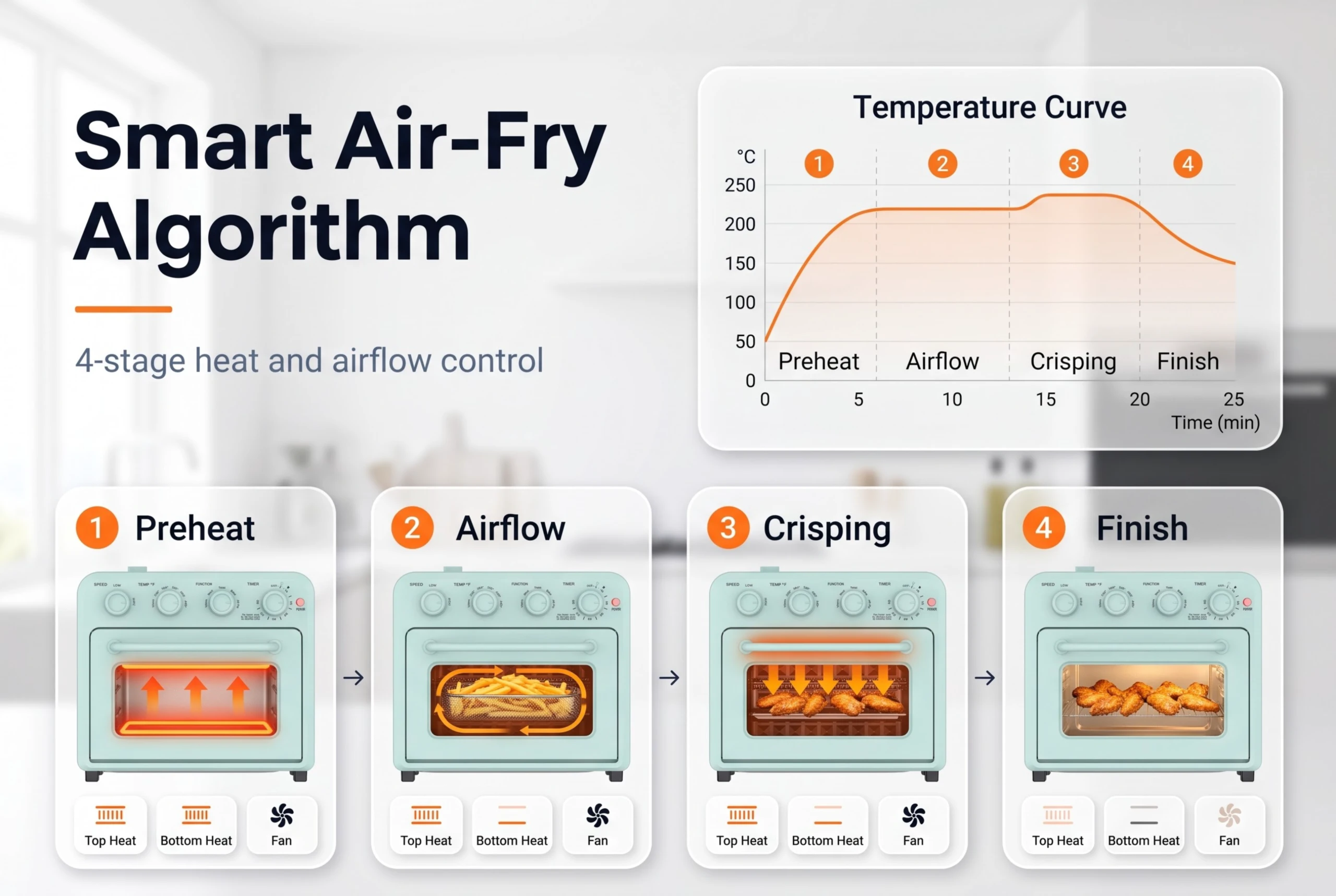
Table of Contents
More than a fan and a heating element
Regular ovens cook with radiant heat and natural convection. Air fryer ovens add a high-speed fan that pushes hot air around the food. That moving air blows away the cool, damp layer sitting on the surface. So food cooks faster, browns better, and gets that fried feel without much oil.
But you can’t just crank the fan and heater to full blast and hope for the best. That’s how you get dry centers, burnt edges, and uneven results. The brain’s job is to keep heat and airflow in sync. Instead of one fixed temperature for the whole cook, a smart air fryer oven follows a temperature curve. That curve comes from a dedicated air-frying algorithm.
The sensing layer: giving the oven feedback
The algorithm can’t do much without feedback. Most smart air fryer ovens rely on a few sensors:
- Temperature sensors, like NTC thermistors, check the cavity temperature in real time.
- Door sensors tell the controller when the oven is open, so heating can pause.
- Fan speed sensors or motor feedback confirm the airflow is steady.
- Some models add humidity, weight, or food-probe sensors to estimate moisture loss or how done the food is inside.
These inputs turn the oven from an open-loop machine into a closed-loop system. The controller compares what the temperature actually is with what it should be. Then it adjusts the heating elements and fan.
The control loop: PID, PWM, and thermal prediction
At the center of it all is a control loop. Many appliances use PID control—proportional, integral, derivative—or a fuzzy-logic version. A PID controller doesn’t just look at the current temperature. It also looks at how long the oven has been off target and how fast the temperature is changing.
Since heating elements are either on or off, the controller uses duty cycling, kind of like pulse-width modulation. To hold 180°C, for example, it might keep the rear element on 70% of the time and the top element on 30%. The fan might run nonstop, or its speed might change in steps.
The algorithm also has to deal with thermal lag. When the oven hits the set temperature, the metal walls and racks are still soaking up heat. A good algorithm sees that coming and cuts power early so it doesn’t overshoot.
Inside the air-frying algorithm: a temperature curve, not a single temperature
A dedicated air-frying algorithm usually breaks cooking into stages. Each stage has its own temperature target, heating-element pattern, and fan speed.
Stage 1: Preheat and thermal soak
The oven heats the cavity to the target temperature. The rear and top elements might run together while the fan spreads the heat. The goal isn’t just to hit the number on the display. It’s to stabilize the whole cavity. A steady thermal environment helps prevent cold spots and uneven browning.
Stage 2: High-heat airflow
Once the food goes in, the algorithm often uses strong convection at a moderate temperature—around 160–180°C. The fan runs fast to speed up moisture evaporation at the surface. The controller may pulse the top and bottom elements alternately to keep air moving and avoid scorching one side.
Stage 3: Browning and crisping
As the surface dries, the Maillard reaction and caramelization can kick in. The algorithm may raise the temperature to 190–200°C and turn on the top element more often. This is the crisp-making stage. The fan may stay high to keep the surface dry, while the controller watches for temperature spikes that could burn the food.
Stage 4: Finish and rest
In the final stage, the algorithm lowers the heat or turns the elements off completely. Residual heat finishes the inside gently, and a lower fan speed keeps moisture from being driven out too aggressively. Some ovens add a keep-warm mode that holds food at a safe temperature without overcooking it.
A typical frozen-food program might look like this: preheat at 200°C, cook at 175°C with the fan on full, then finish at 200°C for a few minutes to crisp. A chicken program might use a lower temperature early to cook the center, then a higher burst of top heat to brown the skin.
Coordinating multiple heaters and the fan
The real intelligence is in the coordination. A smart air fryer oven may have top, bottom, and rear heating elements. The algorithm can turn them on independently or together. The rear element plus the convection fan is usually the workhorse of air frying. The top element adds browning. The bottom element can add base heat for pizzas, pastries, or roasted vegetables.
The fan isn’t just on or off, either. Its speed affects heat transfer, moisture removal, and noise. A high fan speed gives you a crisp exterior, but it can blow lightweight food around. A lower speed is better for delicate items. The algorithm balances these trade-offs based on the preset, the food type, and sensor feedback.
Why this matters for smart kitchen appliances
Smart kitchen appliances aren’t just about Wi-Fi and mobile apps anymore. People expect convenience, consistency, and better results. An air fryer oven with a well-tuned algorithm can give you crispy fries, juicy chicken, and evenly roasted vegetables without you having to babysit the process.
This is also where over-the-air updates and app-based recipes become useful. A manufacturer can improve the air-frying algorithm, add new presets, or adjust temperature curves based on user feedback. The appliance gets smarter over time, even if the hardware stays the same.
The future: adaptive and personalized cooking
The next generation of air fryer ovens will move from preset algorithms to adaptive cooking. Cameras could recognize food type and browning level. Food probes could track internal temperature. Machine learning could adjust the temperature curve based on past results and your preferences. Instead of choosing “fries” or “chicken wings,” the oven might ask how crispy you want them—and then figure out the rest.
Conclusion
The “brain” of a smart air fryer oven isn’t one chip or one sensor. It’s a mix of sensing, closed-loop control, and a carefully designed air-frying algorithm. By managing multiple heating elements and fan speeds in stages, it turns simple hot air into precise, repeatable cooking. The result is the best of both worlds: the convenience of a countertop appliance and the control of a professional kitchen—hidden inside a machine most people just plug in and press start.
