
Have you ever reached for your oven while it was running and immediately pulled your hand back because the exterior was too hot?
An air fryer oven’s interior can reach temperatures above 200°C, yet users touch its door handle, control panel, and outer shell every single day. If those surfaces are burning hot, even the best cooking results won’t make up for it — it’s unsafe and uncomfortable.
“Low Surface Temperature” (LST) technology is designed specifically to solve this problem.
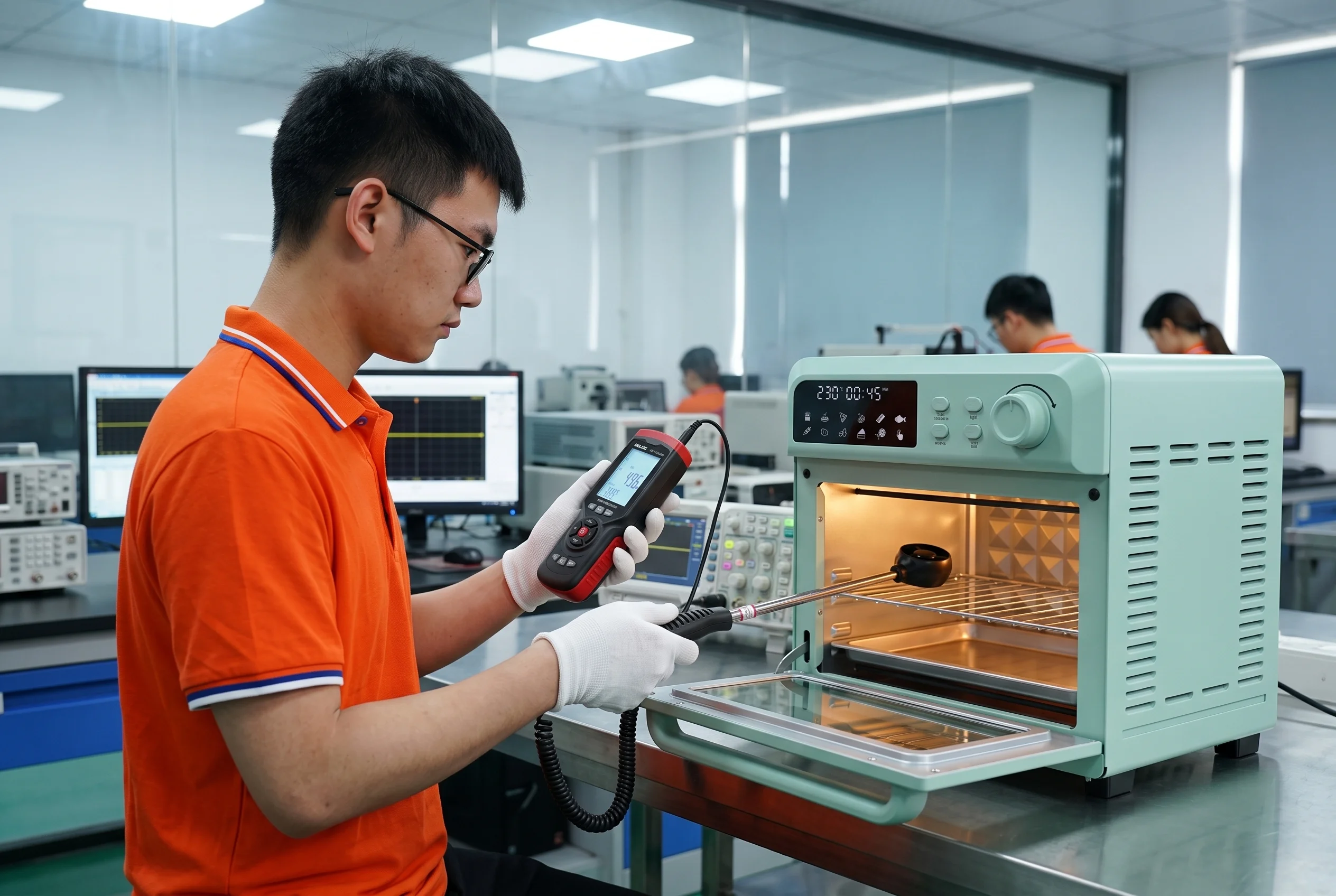
Table of Contents
What Is Low Surface Temperature Technology?
Low surface temperature technology simply means keeping the interior hot while the exterior stays cool.
Sounds obvious? It’s anything but simple. Air fryer ovens typically operate at 175°C to over 200°C inside, while surface temperatures are strictly limited by safety regulations — the gap between the two is huge. Containing that heat inside the cavity without letting it escape to the exterior is a serious engineering challenge.
If the exterior surface temperature runs too high, it doesn’t just affect user experience — it also puts stricter demands on the materials used. Low-temperature plastics may deform or melt, and some decorative metal trims that require lower surface temperatures may become unusable.
Why Is Low Surface Temperature Design So Difficult?
Air fryer ovens are compact appliances — heating elements, fans, food, and housing are all crammed into a very small space. Heat generated by the heating elements is partially used for cooking, but the rest transfers to the outer shell through radiation, conduction, and convection.
Challenge 1: Limited space. A full-size oven has plenty of room for multiple layers of insulation. An air fryer oven doesn’t have that luxury.
Challenge 2: High power density. The same amount of heat is concentrated in a much smaller cavity, creating far higher thermal load per unit area than a standard oven.
Challenge 3: Balancing insulation and cooling. The exterior needs to stay cool, but internal electronic components also need heat dissipation — and insulation and cooling are opposing requirements that must be satisfied simultaneously.
How to Keep It “Cool” — Six Key Technologies
1. Multi-Layer Thermal Barrier Design
Creating multiple layers of thermal barriers between the heating cavity and the outer shell is the most direct way to reduce surface temperatures.
The most basic approach is air gap insulation — leaving precise air layers between the heating cavity and the metal exterior. Air itself is a good insulator. The right spacing prevents heat from transferring directly through the metal structure to the exterior.
More advanced designs incorporate high-performance insulating materials like fiberglass or aerogel into the air gaps. One patented technology places a double-layer reflective heat shield between the oven cavity and the cooling chamber, with additional insulation inside, effectively reducing heat transfer from the cavity to the top cooling chamber.
2. Airflow Optimization — Using Wind to Carry Heat Away
Relying solely on “blocking” heat isn’t enough — you also need to “divert” it.
A carefully designed airflow system lets cool air enter from specific points, flow through heating zones, and exit through exhaust vents, carrying excess heat away.
One patent leverages the natural tendency of hot air to rise, allowing the air fryer to dissipate heat rapidly and reduce exterior temperature rise. Combined with air-guiding structures that mix hot and cold air, it further lowers exhaust temperatures.
Another design specifically targets the door assembly — using an exhaust structure to turn the door into a through-flow air duct. A fan on the motor assembly draws heat out of the door cavity, lowering both door surface and handle temperatures. This means the inner door glass doesn’t require expensive LOW-E glass to meet safety standards.
3. Partitioning with Heat Shields
Installing partition plates inside the oven body divides the cavity into different zones. The cooking chamber handles the food; the insulated chamber blocks heat from reaching the exterior. Adding a heat shield at the top of the cavity prevents heat from rising to the top cover — which is often the most frequently touched surface.
4. Heating Element Layout Optimization
The position and shape of heating elements directly affect how much heat radiates toward the exterior.
Spiral, M-shaped, U-shaped, and other geometries aren’t just about even heating — a well-designed layout directs more heat toward the food and less toward the housing. Keeping sufficient distance between heating elements and the outer shell, combined with reflectors that “bounce” heat back into the cavity, also significantly reduces exterior temperatures.
5. Material Selection
The thermal conductivity of the exterior material determines how fast heat travels through it.
Metal exteriors conduct heat quickly — heat spreads evenly across the surface but radiates from a larger area. Plastic exteriors conduct heat slowly — localized heat doesn’t spread easily, potentially creating “hot spots.” Using low-thermal-conductivity materials in critical areas, or adding thermal barrier coatings to the inside of metal shells, are effective complementary measures.
6. Smart Temperature Control and Active Cooling
High-end air fryer ovens feature intelligent temperature control systems that monitor exterior temperatures in real time. When temperatures approach safety thresholds, the system actively adjusts heating power or activates cooling fans.
This active temperature management is more flexible than passive insulation — it dynamically balances internal cooking performance with exterior surface safety.
What Do Safety Standards Say?
Low surface temperature design isn’t just about user experience — it’s legally required.
IEC 60335-2-9 is the international safety standard for portable cooking appliances, covering grills, toasters, and air fryer ovens. Clause 11 specifies exactly how surface temperatures must be measured, and Table 102 sets the limits for temperature rises on external surfaces.
The updated European standard EN IEC 60335-2-9:2023+A11:2023 imposes even stricter surface temperature requirements. Surfaces within 25mm of vents are now subject to tighter limits. If the total area of these vent-adjacent surfaces exceeds 20% of the total accessible surface area, they must comply with Table 102 limits. Surface temperature requirements for ovens and similar baking appliances have long been a major hurdle in CE and GS certification.
North American markets are equally strict. UL 1026 applies to household cooking appliances, covering electrical safety, temperature protection, mechanical strength, and fire resistance. UL 60335-2-9 aligns with the IEC standard.
Specific temperature rise limits: metal surfaces must not exceed 70K (Kelvin), plastic surfaces must not exceed 85K. Handles and other gripping areas are limited to 35K, while short-term contact areas are capped at 45K.
These aren’t suggestions — they’re mandatory market access requirements. Products that fail to meet these standards cannot obtain CE, GS, UL, or other certifications, which means they cannot enter European or North American markets.
What Does Low Surface Temperature Mean for Your Brand?
For brands, low surface temperature design isn’t just about “compliance” — it’s a core product differentiator.
Better user experience. An air fryer oven that doesn’t burn your hand feels safer and more comfortable to use. For families with children, “I don’t have to worry about my kid touching it” is a powerful purchase driver.
Fewer after-sales complaints. “The exterior gets too hot” is a common negative review. Low surface temperature design directly reduces these complaints.
Stronger brand trust. Consumers may not understand convection heating or the Maillard reaction, but “this machine doesn’t get hot on the outside” is a quality signal they can feel. As one industry insider put it, low surface temperature technology enhances both safety and user experience.
Wider market access. Compliance is a prerequisite for entering European and North American markets. Better low surface temperature design means higher certification pass rates and shorter approval cycles.
Final Thoughts
Low surface temperature in air fryer ovens is a systems engineering challenge — multi-layer insulation, airflow optimization, cavity partitioning, component layout, material selection, and smart temperature control all working together.
It solves more than a technical problem — it solves a customer trust problem. When a 200°C machine feels warm but not hot to the touch, users perceive safety, quality, and a brand they can trust.
Great design is invisible. Low surface temperature technology is exactly that — it works silently behind the scenes, letting you enjoy your meal without ever worrying about getting burned.
