
If you’ve ever pulled a batch of french fries from your air fryer only to find some pieces perfectly golden while others remain pale and undercooked, you’ve experienced the frustration of inconsistent temperature control. The culprit? Insufficient insulation.
While much has been written about the powerful fans and rapid air circulation that define air fryer cooking, insulation technology is the unsung hero that makes consistent results possible. It’s the thermal barrier that transforms a simple hot-air box into a precision cooking instrument. Here’s how it works—and why it matters more than you might think.
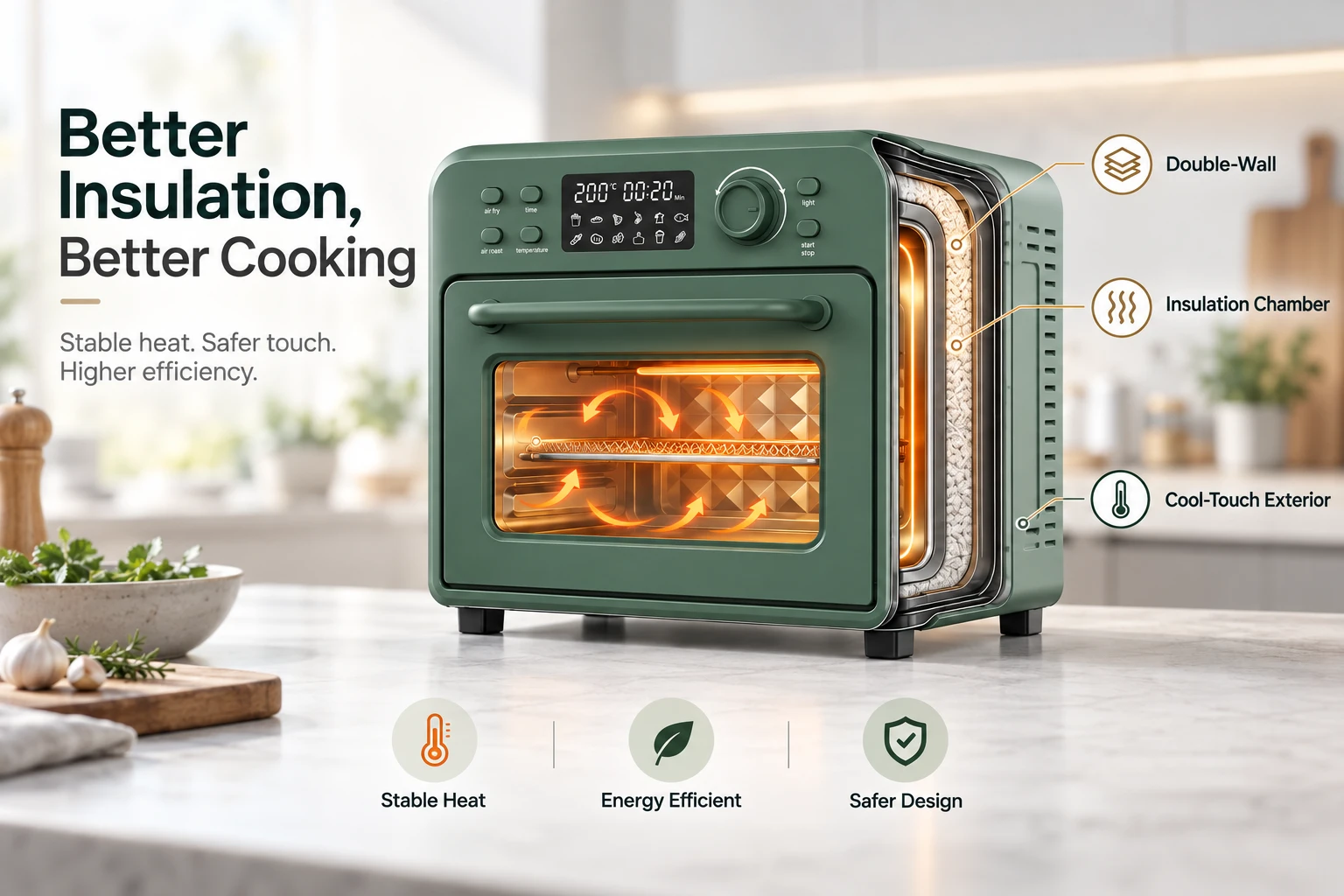
Table of Contents
The Core Challenge: Keeping Heat Where It Belongs
Inside an air fryer oven, temperatures routinely reach 200°C (400°F) or higher. The heating element generates intense heat, and the fan circulates that superheated air around the food at high velocity. But heat, by its nature, wants to escape. Without proper insulation, that heat radiates outward through the appliance walls, causing three interrelated problems:
- Temperature fluctuations inside the cooking chamber, as heat constantly leaks out and the heating element cycles on and off to compensate
- Uneven cooking, since areas near the walls lose heat faster than the center
- Hot exterior surfaces that pose burn risks and waste energy
Insulation technology addresses all three challenges simultaneously.
How Insulation Works: The Engineering Behind Thermal Stability
The Insulation Chamber Concept
At its most fundamental level, insulation in an air fryer creates a thermal barrier between the hot cooking cavity and the outside world. Advanced designs incorporate a heat insulation component that matches the outer wall of the cooking cavity, forming a dedicated heat insulation chamber filled with a heat insulation medium.
This chamber—essentially an air gap or a layer of insulating material—traps heat inside the cooking cavity, preventing it from escaping to the exterior. The result is twofold: the cooking environment remains stable at the set temperature, and the outer surface stays significantly cooler.
Double-Wall Construction
One of the most effective insulation strategies is double-wall construction. A well-engineered air fryer uses an inner shell and an outer shell with an air gap between them. Air is a poor conductor of heat, so even a modest gap—some designs use a 15mm insulating air gap—dramatically reduces heat transfer from the hot interior to the exterior surface.
This is sometimes combined with high-density thermal batting or other insulating materials within the gap, creating what manufacturers call “Thermal-Shield” technology. The result: even after an hour of high-temperature roasting, the outer skin of the appliance can remain below 45°C—well below the threshold for skin burns.
Strategic Material Selection
The choice of insulation materials is critical. High-performance air fryers use materials with low thermal conductivity—meaning they resist the flow of heat. Common options include:
- Insulation cotton or aerogel felt—materials with excellent heat insulation properties that effectively trap heat
- High-temperature resistant insulating materials such as insulation ceramic, XPS extrusion materials, and high-temperature alloys
- Silicone gel or materials with equivalent properties—typically applied in layers 1–3 mm thick
- Fiberglass insulation—commonly used to retain the vast majority of heat inside the cooking cavity
- Mica—which can withstand temperatures above 600°C while remaining stable, non-flammable, and odorless
Some premium models even incorporate aerogel insulation liners—a material originally developed for aerospace applications—to achieve superior thermal performance while minimizing bulk.
Cool-Touch Exterior Design
The cumulative effect of these insulation strategies is what manufacturers market as a “cool-touch” exterior. While there is no standardized temperature threshold that defines “cool-touch,” well-engineered designs can maintain exterior surface temperatures below 100°F (approximately 38°C) during normal operation.
This is achieved through multiple engineering approaches working together:
- Double-wall construction with insulating air gaps
- Heat-resistant polymers and engineered plastics with low thermal conductivity for the outer housing
- Strategic ventilation that directs hot exhaust air away from exterior surfaces
- Isolated handles and control panels positioned away from heat sources
What This Means for Your Cooking
Temperature Stability = Consistent Results
The primary benefit of effective insulation is temperature stability. When heat stays trapped inside the cooking chamber, the appliance doesn’t need to constantly cycle the heating element on and off to compensate for heat loss. The result is a steady, predictable cooking environment.
This matters because uneven heat can ruin dishes, leading to undercooked or overcooked results. With stable temperatures, whether you’re frying, baking, or roasting, you achieve even cooking across every piece of food. Delicate tasks like baking or dehydrating particularly benefit from this precision.
Faster, More Efficient Cooking
An air fryer operates in an insulated box, which dramatically increases cooking efficiency. The heating elements and cooking area are smaller than those of a conventional oven, but because the insulation traps heat so effectively, the appliance heats up quickly and maintains temperature with minimal energy waste.
Most air fryers preheat in about five minutes—compared to 15 minutes for a conventional oven—and cook foods in roughly half the time.
Energy Efficiency
Effective insulation doesn’t just improve cooking—it also reduces energy consumption. By trapping heat inside the cooking chamber, the appliance uses less power to maintain cooking temperatures. Well-insulated appliances consume significantly less energy over time, making them more economical to operate and more environmentally friendly.
Safety
Perhaps the most immediately noticeable benefit is safety. Insulation keeps heat inside the oven, not on the exterior. This is particularly vital in households with young children, curious pets, or elderly family members who may accidentally brush against the unit during operation. A cool-touch exterior also protects countertops and nearby appliances from heat damage.
The Takeaway
Insulation technology in air fryer ovens is far more than a passive feature—it’s an active enabler of consistent, reliable cooking. By creating a thermal barrier between the intense heat of the cooking cavity and the outside world, insulation ensures stable temperatures, reduces energy waste, speeds up cooking, and keeps the appliance safe to touch.
The engineering behind this is sophisticated: double-wall construction, strategically chosen insulating materials, and thoughtful design all work together to trap heat where it belongs. The result is an appliance that delivers perfect results, batch after batch—not by chance, but by design.
The next time your air fryer produces flawlessly golden fries or a perfectly baked cake, remember: it’s not just the fan doing the work. It’s the insulation that made it all possible.
