
Let’s cut through the noise. If you’ve spent any time on social media, you’ve seen the air fryer cult. Crispy chicken wings. Perfect roasted potatoes. Even donuts. The hype is deafening.
But you’re not a home cook scrolling for dinner ideas. You’re a brand owner, product developer, or procurement manager trying to figure out if this category is worth your investment — or just another kitchen gadget fad that will collect dust in storage rooms.
I’ve looked at the data, tested the products, and watched the market shift. Here’s the unvarnished truth about air fryer ovens — what they actually do, how they compare to regular ovens, and whether this category has real staying power.
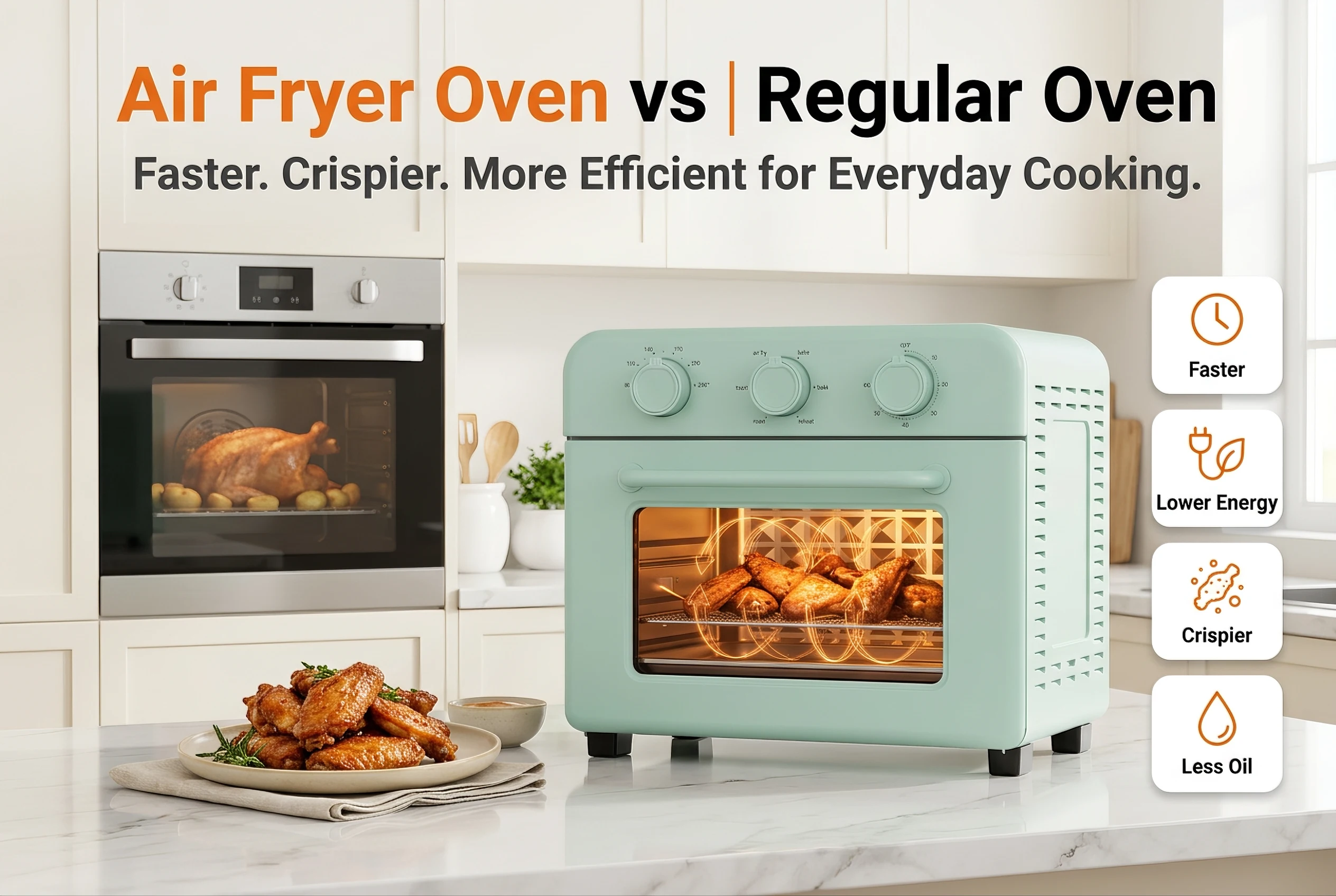
Table of Contents
The Honest Comparison at a Glance
| Title | Short Description |
|---|---|
| The Core Tech | Forced hot air vs. still radiant heat. |
| Footprint | Countertop space vs. wall cavity. |
| Cook Time | 2-min preheat vs. 15-min waiting. |
| Power Use | Half the wattage of a big oven. |
| Texture Win | Crispier crust every single time. |
| Health Edge | 80% less oil than the deep fryer. |
Wait — Does an Air Fryer Actually “Fry” Anything?
No. And the name is the best marketing trick in kitchen history.
An air fryer is essentially a convection oven on steroids. It’s a heating element at the top, paired with a fan that moves air so fast it creates a whirlwind inside a tiny chamber. That wind hits the food, triggers the Maillard reaction (the browning magic), and gives you that crispy shell everyone craves. Meanwhile, excess grease drips through a perforated basket, leaving the food less oily and more textured.
The genius of the design is concentration. Because the chamber is small, the heat has nowhere to escape. It’s intense, immediate, and consistent — a level of performance that a large oven simply cannot match because of the sheer volume of air it has to heat.
For the consumer, that translates to:
- Faster cooking (less waiting, more eating)
- Crispier textures (the difference is not subtle)
- Lower energy bills (less power, shorter run times)
- Healthier meals (oil is optional, not mandatory)
How Does a Regular Oven Cook Differently?
A regular oven is a blunt instrument. It heats the air inside a big metal box and waits for the food to catch up.
Conventional ovens use radiant heat from top and bottom elements. The air is mostly still. In a convection oven, a fan at the back moves air around — but even then, the chamber is so large that the heat feels gentler, slower, and less aggressive than an air fryer.
The oven wins on capacity and versatility. You can fit whole turkeys, sheet pans, casseroles, and baking trays. You can bake delicate pastries that need gentle, even heat. You can cook multiple dishes at once.
The oven is a marathon runner. The air fryer is a sprinter.
The Real Differences — What Actually Matters
1. Size and Capacity — Apples and Watermelons
Air fryers sit on your counter. Ovens sit in your wall.
Air fryers typically handle one dish at a time. The basket size ranges from small (enough for one person) to large (enough for a small family). Ovens handle multiple racks, multiple dishes, and massive portions.
If you’re cooking for one or two, the air fryer is perfect. If you’re hosting Thanksgiving, the oven is non-negotiable.
2. Speed — The Air Fryer’s Superpower
Preheating an oven is an exercise in patience. Preheating an air fryer is almost unnecessary.
- Oven preheat: 10–15 minutes.
- Air fryer preheat: 2–3 minutes, or sometimes zero.
Cooking times are also significantly shorter. Chicken thighs that take 30 minutes in an oven can be done in 20 minutes in an air fryer. That’s a 33% time savings — not trivial when your customers are busy parents or working professionals.
For brand owners, speed is a compelling message. “Dinner in 20 minutes” sells.
3. Energy Efficiency — The Hidden Economic Driver
Air fryers are cheap to run. Ovens are not.
- A typical air fryer uses 1,500 watts.
- A full-size electric oven draws 2,500 to 5,000 watts.
CNET calculated that air fryers use about 50% less energy than a traditional wall oven. One UK test found that cooking chips costs 10–12p in an air fryer versus 45–55p in an oven.
At scale, those savings add up to real money — and consumers are paying attention to their utility bills.
4. Texture — The Air Fryer’s Crown Jewel
This is where the air fryer wins, and wins convincingly.
In side-by-side tests, the air fryer consistently produces crispier, more evenly browned food. Vegetables come out with charred edges. Chicken skin turns glassy and crackling. Even reheated leftovers regain their original texture — something an oven cannot do.
The reason is physics: concentrated heat + high velocity air extracts surface moisture faster, creating that caramelized crust while keeping the interior moist.
For consumers, this is the “wow” factor that drives word-of-mouth. They don’t tell their friends about the preheat time. They tell them about the crispy chicken.
5. Health — The “Guilt-Free” Positioning
Air fryers are healthier. That’s not marketing fluff — it’s science.
- They use up to 80% less oil than deep frying.
- They reduce acrylamide (a potential carcinogen) in starchy foods.
- Dietitians confirm they’re a healthier cooking method because they essentially eliminate added oils.
Health-conscious consumers are a large and growing segment. This is not a niche angle — it’s a mainstream value proposition.
The Verdict: Are Air Fryer Ovens Worth the Hype?
Yes — with one important clarification.
Air fryers are genuinely good at what they do. They cook faster, crispier, and healthier than most ovens. They are energy efficient and easy to use. Consumer tests consistently rank them highly, with performance ratings often exceeding 85%.
But they are not oven replacements.
An air fryer is a specialist. It excels at small-batch cooking that prioritizes texture and speed. A regular oven is a generalist. It handles large quantities, diverse cooking methods, and delicate baking.
When the air fryer wins:
- Weeknight dinners that need to be fast and delicious
- Snacks and sides — fries, wings, roasted vegetables, reheated pizza
- Small households or single-person cooking
- Summer cooking when you don’t want to heat up the kitchen
When the oven wins:
- Baking cakes, breads, and pastries that need steady heat
- Cooking for groups or large family meals
- Multi-dish meals where timing needs coordination
- Dishes that won’t physically fit in an air fryer
The Market Data — Why This Category Matters for Brands
If you’re evaluating whether to enter this category, the numbers are persuasive.
- The global air fryer market was valued at $1.4 billion in 2024** and is projected to reach **$2.9 billion by 2034 — a CAGR of 7.80%.
- The air fryer oven segment specifically is expected to grow from $1.4 billion in 2025 to **$4.5 billion by 2035** — a CAGR of 12.3%.
- In China, 2025 retail volume grew 4.2% and retail value grew 8.2%, with average selling prices increasing 3.8%.
This is not a passing trend. It’s a growing category with consumer adoption, technological refinement, and price escalation all moving in the right direction.
What This Means for Your Brand Strategy
If you’re developing an air fryer oven product line, here’s what I’d recommend based on the data:
1. Lead with speed and texture. These are the two features consumers experience most directly. “Faster than an oven, crispier than a microwave” is a simple, clear message.
2. Make health a central pillar. Up to 80% less oil is a number that resonates. Health-conscious consumers are making purchase decisions based on this.
3. Be honest about capacity. Don’t pretend an air fryer replaces a full oven. Instead, position it as the “everyday cook” that handles 80% of meals — and the oven handles the other 20%.
4. Consider tiered offerings. A compact model for small households. A family-size model for larger kitchens. A premium model with smart features and better CMF. The market is maturing — don’t sell a single product when you can sell a lineup.
5. Don’t ignore certification. North America requires ETL/UL. Europe requires CE/GS. Make sure your factory partner has the compliance framework to get you to market without regulatory delays.
The Bottom Line
Air fryer ovens are not a fad. They solve real consumer problems — speed, texture, health, and energy cost — in a way that ovens cannot match.
But they are not replacements. They are complements. Specialist tools that enhance, not replace, the traditional oven.
The smartest brands in this category don’t position air fryers as “oven killers.” They position them as “everyday cooking companions” — the appliance you reach for on a Tuesday night when you just want dinner to be easy, fast, and delicious.
That’s a positioning that sells — and one that builds lasting brand loyalty.
