
Welcome to LINDEN INTELLIGENT
For appliance brands, importers, and private-label sellers, the biggest decision is often not the product color or the control panel. It is the manufacturing model behind the product. In the air fryer oven category, OEM and ODM are the two most common paths, and each one serves a very different business strategy. OEM is generally the better fit when a brand needs a more exclusive product identity, while ODM is usually faster when the priority is market entry, lower risk, and a proven platform.
At Linden, the conversation is not just about production. The company presents itself as an engineering-driven OEM/ODM partner for countertop kitchen appliances, with in-house manufacturing, 15+ production lines, CE / ETL / RoHS support, export experience in 20+ countries, and certifications including ISO, BSCI, CB, LFGB, and FDA on its site. That matters because the right manufacturing model is only valuable when the factory can actually support design, quality, and repeatable mass production.
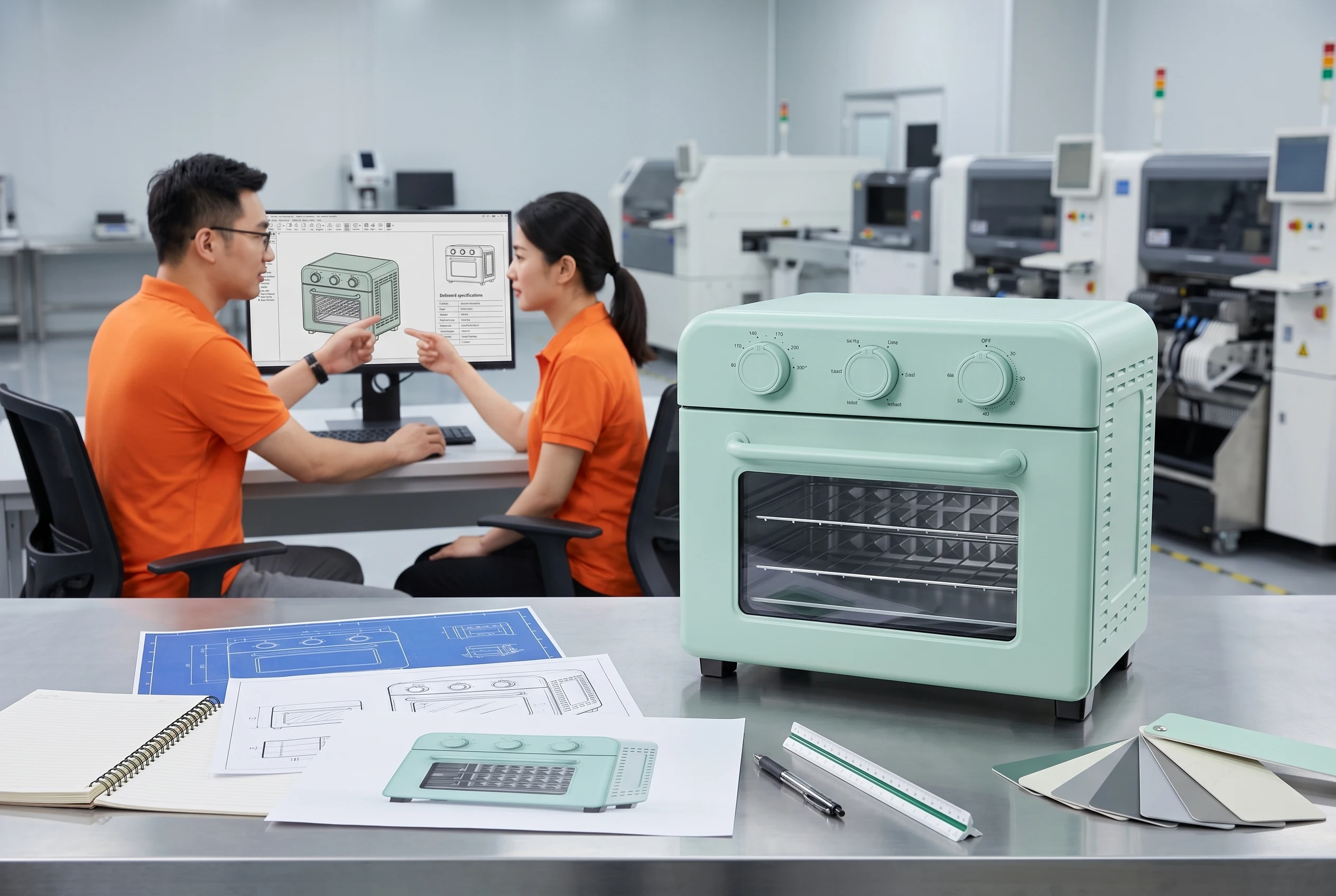
Table of Contents
What Is OEM Air Fryer Oven Manufacturing?
OEM, or Original Equipment Manufacturing, means the product is built to the buyer’s design direction. In an OEM air fryer oven project, the brand may define the industrial design, cooking layout, interface, handle structure, front panel, finish, packaging direction, and even a unique internal cooking configuration. The factory then turns that concept into engineering drawings, tooling, samples, and mass production.
OEM is powerful when the product itself is part of the brand story. For example, a brand may need a distinct visual identity, a premium interface, a special window design, or a cooking system that is different from what is already on the market. The trade-off is time and investment: OEM usually takes longer, requires more technical coordination, and often involves higher early-stage cost.
What Is ODM Air Fryer Oven Manufacturing?
ODM, or Original Design Manufacturing, starts from a ready-developed platform. The factory already has a tested structure, and the buyer customizes the branding, color, packaging, accessories, and selected functions. In the reference article, Linden notes that ODM platforms may cover multiple capacities such as 12L, 16L, 22L, and 30L, which gives brands a practical starting point without beginning from zero.
ODM is usually the better route for brands that need speed, predictable cost, and lower launch risk. It is especially practical for importers, distributors, Amazon sellers, and private-label businesses that want to test a market before committing to a fully custom model. A mature ODM platform also shortens the engineering path because the core structure has already been validated.
OEM vs ODM: Key Differences for B2B Buyers
The simplest way to compare the two models is to ask whether the brand is buying a concept or buying time.
OEM gives more control over appearance, structure, interface, and feature architecture. ODM gives faster speed, lower development pressure, and a clearer starting cost structure. In the article, OEM is described as having higher customization depth and higher early-stage risk, while ODM is described as more predictable and faster to launch.
That is the business headline, but there is a deeper layer: the real decision is not only about customization. It is also about how much uncertainty your brand can carry in the first 90 to 180 days after launch. OEM creates stronger differentiation, but it also creates more variables. ODM reduces variables, but it may be harder to defend on shelf if the market is crowded.
How to Choose the Right Manufacturing Model
1. Product Differentiation
Choose OEM when the product itself must look and feel different from the market. If your brand is competing on design identity, premium user experience, or a unique cooking story, OEM is often the smarter long-term move. Choose ODM when the goal is to enter the market quickly with a reliable product foundation and let branding, pricing, and channel execution do the heavy lifting.
A useful test is this: if a buyer can place your product next to three competitors and still not clearly understand why yours exists, the project may need stronger OEM-level differentiation. If the product already fits a clear need and only needs brand localization, ODM may be enough.
2. Launch Timeline
If the launch window is tight, ODM usually wins. A tested platform cuts down the time needed for structure design, sample revision, and production preparation. OEM can absolutely deliver a better long-term asset, but only when the brand can afford a longer development cycle.
A fast launch is not only about getting to market earlier. It also matters when the brand is following seasonality, retailer deadlines, marketplace ranking windows, or promotional campaigns. In those situations, ODM can protect momentum.
3. Budget and MOQ
OEM normally requires more budget discipline because it may involve engineering work, tooling, and additional sample rounds. ODM usually offers a clearer path to controlling the first order budget and makes it easier for new brands to test demand before scaling. The reference article also advises buyers to discuss MOQ, packaging, and accessory configuration early in the process, which is essential because those choices affect unit economics more than many teams expect.
This is one of the most overlooked issues in kitchen appliance projects: the cheapest-looking quote is not always the lowest-risk launch. Packaging size, plug type, manuals, accessories, and carton tests can quietly shift cost and lead time.
4. Target Market and Sales Channel
Different channels reward different product strategies. The reference blog positions 12L as an entry model, 16L as a mainstream bestseller, 22L as a flexible mid-premium option, and 30L as a large-capacity premium model. That capacity ladder is useful, but the channel matters just as much as the size. A compact model may work better in marketplaces and small-kitchen retail, while a larger model may be more persuasive in premium offline channels where visual impact and perceived value matter more.
For brands selling across multiple channels, the best strategy is often a SKU ladder rather than a single hero model. That lets the company protect a budget entry point, a volume seller, and a premium upsell without forcing one product to do every job.
5. Certification and Quality Control
Certification is not a final-step task. It should shape the product plan from the beginning. The reference article notes that international buyers should confirm support for safety testing, performance verification, material control, packaging drop tests, and production quality inspection. Linden’s site also highlights CE / ETL / RoHS support and lists ISO, BSCI, CB, LFGB, and FDA among its export-ready capabilities.
For brands that sell internationally, quality control should include more than product function. It should also cover thermal consistency, temperature accuracy, accessory fit, outer-surface heat management, and packaging resilience. Linden’s site specifically highlights convection heating, optional steam technology, precise temperature control, and thermal insulation as core technologies, which are the kinds of engineering details that can affect customer satisfaction after launch.
A Better Way to Think About Capacity Strategy
Capacity should not be treated as a pure technical specification. It is a positioning decision.
A 12L model often signals compact, easy placement, and lower entry price. A 16L model can feel like the safest mainstream choice for family use and online retail. A 22L model supports broader cooking flexibility and more recipe scenarios. A 30L model creates a stronger premium presence and can support larger households or more upscale merchandising.
The sharper question is this: which capacity gives your brand the best combination of perceived value, price elasticity, and repeat purchase potential? In many cases, the answer is not the biggest model. It is the model that best matches how your customer cooks, shops, and compares products.
When Should You Choose OEM?
OEM is usually the better choice when your brand needs a product moat.
Choose OEM when you already have a clear product concept, want a distinctive look or structure, and can accept more time and investment in development. It is also the right direction when you need deeper customization in the panel, interface, handle, color, accessories, or internal structure.
OEM becomes especially valuable when your brand is building a long-term portfolio, not just filling a short-term sales gap. If the product is meant to become a signature item, OEM gives you a stronger foundation.
When Should You Choose ODM?
ODM is usually the smarter choice when speed and market testing matter more than uniqueness.
Choose ODM when you want a proven platform, a faster launch, a lower-risk starting point, and more predictable budgeting. It is also a strong fit when your main customizations are logo, packaging, panel styling, accessories, or minor color adjustments. The reference article also notes that ODM is useful for repeat orders and faster sample confirmation, which makes it practical for channel-driven businesses.
For many private-label brands, ODM is not a compromise. It is a launch strategy. The brand can validate demand first, then decide whether to deepen customization later.
A Smarter Hybrid Strategy: Start ODM, Then Move to OEM
This is the part many blogs skip.
A hybrid approach often works best for brands that want to reduce risk without giving up long-term differentiation. Start with an ODM platform to test pricing, content, channel response, and customer feedback. Then use that data to define a future OEM version with sharper design, better user experience, or a stronger feature set. The result is a cleaner roadmap: launch first, learn fast, then invest with evidence.
That approach is especially effective in air fryer ovens because consumer feedback often reveals which features truly drive conversion: visibility, capacity, presets, steam support, panel simplicity, or cooking consistency. A strong factory partner can help translate that feedback into a roadmap instead of forcing the brand to guess.
How a Reliable Air Fryer Oven Manufacturer Can Support Your Project
A reliable manufacturer should do more than make units. It should help the brand reduce decision risk.
Linden’s website positions the company as an engineering-driven partner that can support design and engineering, custom functions and features, modern user interface controls, and quality production with certificates. It also highlights direct support from concept to mass production, which is exactly what B2B buyers need when moving from an idea to a market-ready appliance.
In practical terms, a strong partner should help with product definition, market-fit advice, technical review, sample development, compliance planning, packaging, and stable production follow-through. That support is especially important in air fryer oven projects, where a small design decision can affect heat flow, usability, shelf appeal, and after-sales satisfaction.
Conclusion
OEM and ODM are not competing labels. They are two different growth tools. OEM is the better path when your brand needs exclusivity, stronger differentiation, and a product built around your own concept. ODM is the better path when you need speed, lower risk, and a reliable platform that can reach the market sooner.
The best decision starts with five questions: how different must the product be, how fast must it launch, how much budget can the project carry, which channels will sell it, and what level of certification and quality control is required. Once those answers are clear, the right model becomes much easier to see. For Linden, the published capabilities suggest a partner structure built for both routes, which gives brands room to choose the path that fits their strategy rather than forcing a one-size-fits-all solution.
FAQ
Q1: Is OEM always better than ODM?
No. OEM is better for differentiation, but ODM is often better for speed, risk control, and first-time market testing.
Q2: Which model is better for new brands?
ODM is usually the safer starting point because it reduces development complexity and helps control early costs.
Q3: Can a brand start with ODM and later switch to OEM?
Yes. That is often a smart growth path because it lets the brand validate demand before investing in a custom platform.
Q4: What should I ask a manufacturer before starting?
Ask about MOQ, tooling, sample timeline, certification support, customization depth, packaging options, and quality inspection process. The reference article and Linden’s site both show that these factors directly affect project success.
Q5: What makes Linden relevant for this kind of project?
Its site describes in-house manufacturing, engineering-led development, 15+ production lines, export experience, and support for multiple compliance standards, which are all useful for OEM and ODM appliance projects.
