
Subtitle: Stop the endless mold-making madness – use one thermal engine to rapidly spawn a full family that covers every price tier
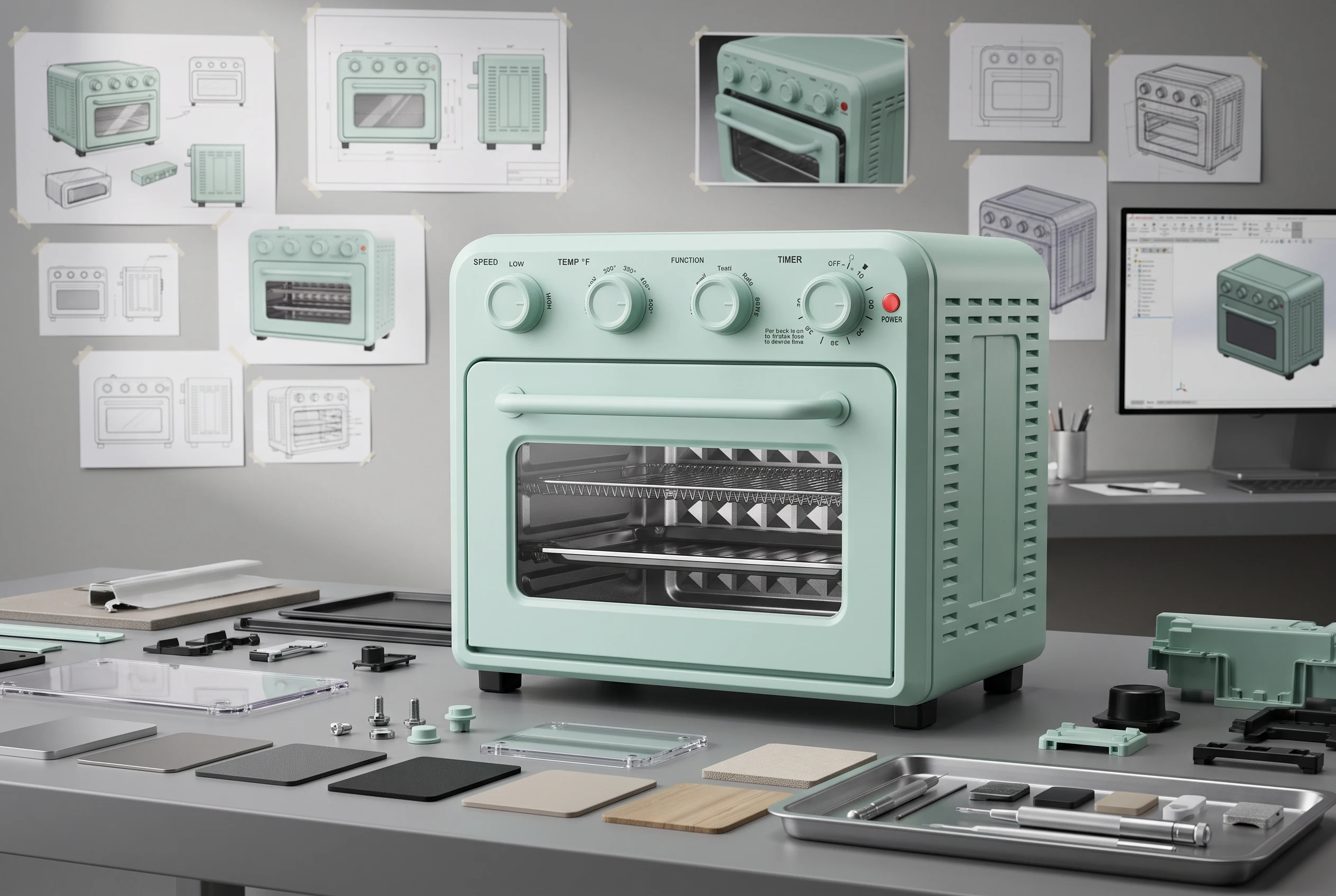
Table of Contents
Introduction: The wise warrior first seeks to avoid defeat, then seeks victory
When I consult with brand owners on product strategy, I always ask one fundamental question: Are you actually selling “ovens,” or are you selling a “thermal management algorithm”?
If your answer is the latter, congratulations – you’re already thinking from first principles. Most factory-driven sellers get trapped in the physical combination of “sheet metal + heating rods + glass.” So every new model means a new structural design, new molds, new safety certifications – expensive and painfully slow.
But if we look at the history of global consumer goods, every great durable-goods brand (Tesla in cars, Apple in phones) follows the same underlying logic: platform-based architecture.
Sun Tzu said: “In all fighting, the direct method may be used for joining battle, but the indirect method will be needed in order to secure victory.” In the fiercely crowded air fryer toaster oven space, your “direct” method is your core heating platform – that’s your foundation. The “indirect” method is the variations in size, aesthetics, and features that spring from that platform – those are your surprise attacks on specific market segments.
Today, I’m going to break down, step by step, how to use one core platform to build an entire product empire.
Part 1: Deconstructing the “Core Platform” – What Is Your “Thermal Engine”?
In platform-based architecture, the first step is not to draw exterior renderings. It’s to define your non‑negotiable core assets. Borrowing from Elon Musk: cost lives in materials, not in fancy manufacturing processes.
For an air fryer toaster oven, your core “first‑principles” platform must include these three unchangeable subsystems:
- Heating System (the thermodynamic heart) – This is the soul. It includes the top carbon‑fiber/stainless‑steel heating tubes, the bottom concealed heating element, and the high‑speed turbo fan that makes “air frying” actually work. The stability of this system and its temperature‑control curve (PID algorithm) determine cooking success.
- Control System (the brain and neural network) – This covers the main PCB, NTC thermistor sensors, and the core firmware algorithm. This algorithm should pre‑load at least 8–10 basic cooking profiles (e.g., fries, steak, baking, dehydration).
- Cavity Fluid Dynamics (the skeleton) – The internal dimensions, width‑to‑height ratio, and airflow path. These dictate whether hot air evenly surrounds the food.
Business Insight (Buffett & Munger lens): Invest 80% of your R&D budget and effort into these three elements to ensure your “engine” is among the top 5% in durability and accuracy. That’s your moat. Once these three are finalised and rigorously tested, your development risk drops by 80%.
Part 2: The Art of Variation – How to “Derive” Product Lines Like Lego Bricks
Once your core platform is validated, we move to the “building block” phase. This is where platform architecture truly shines: using the same certifications (UL/CE/ETL), the same supply chain, to attack different consumer mindsets.
Using market‑segmentation theory (the “high‑dimensional growth” framework), you can rapidly create a matrix by varying the following “surface‑level variables”:
2.1 Capacity Derivatives (vertical segmentation)
- Entry (10–12L) – Miniaturised adaptation of the core platform. Targets singles and couples – “compact, no pre‑heat needed.” Messaging: “Just right for one.”
- Mainstream (16–20L) – Direct application of the standard platform. For 3‑person families – fits a whole chicken. This is your volume‑driven profit cow.
- Premium (26–30L) – Same platform, just a larger outer cavity and adjusted fan blade angles. For baking enthusiasts / parties – multi‑layer even cooking.
Key strategy: Three capacities, one production line. Adjust internal mold spacers. BOM (Bill of Materials) overlap can reach 70%.
2.2 Aesthetic Derivatives (horizontal segmentation)
- Minimalist Industrial (brushed metal / black glass) – For mainstream Western households – looks like a kitchen showpiece.
- Retro Pastel (colourful finishes / rounded shapes) – Targets younger, female‑centric social‑media users – designed for TikToks and Instagram posts that scream “aesthetics first.”
- Professional Rugged (full stainless, exposed screws, industrial handles) – For serious food bloggers – gives that “commercial‑grade” vibe.
Key strategy: Outer shells (covers, handles, knobs) are completely independent “skins.” The core assembly simply slots inside. Change the skin = change the brand personality, without re‑running reliability tests.
2.3 Feature Derivatives (software‑defined hardware)
This is where the highest profit margin lies. Since we already have a smart PCB, we can differentiate tiers simply by enabling or disabling features in software – no new hardware R&D needed:
- Entry – Mechanical dials (optionally analogue), basic timer + temperature – simple and bulletproof.
- Mid‑range – Touch controls, 8 preset menus (different screen silk‑screening).
- High‑end – Add WiFi/Bluetooth, app connectivity, OTA firmware updates, even NFC recipe sharing.
Tech Insight (Steve Jobs mindset): Consumers don’t buy features; they buy a “better version of themselves.” The high‑end model sells “tech mastery”; the entry model sells “built‑like‑a‑tank reliability.” The actual hardware cost difference is under US$50, but the retail price can easily be US$150 higher.
Part 3: Why Must Brands Embrace “Platformisation”? – The Brutal Maths of Cost and Efficiency
Let me give you a cold, hard business reality: if you only sell a single SKU next year, your marketing costs (customer acquisition) will eat so much of your margin that you’ll barely break even. You need a product matrix to capture traffic from different channels – SEO search terms, social hashtags, and retailer categories.
Here are three “victory‑without‑battle” advantages platformisation delivers:
- Development Costs Plunge (60%+ savings)
- Traditional model: 3 products = 3 sets of moulds + 3 safety certifications (often six figures in total) + 3 separate supply‑chain ramp‑ups.
- Platform model: 1 high‑precision core mould + 2 smaller variant moulds (for shells). Do only one series certification – the lab tests the core, and variants are covered under the same family. What used to take 18 months can be compressed to 6–8 months.
- Inventory Turnover – The Battle of Survival (Sun Tzu’s “Chapter on Military Disposition”)
- “First make yourself invincible, and then wait for the enemy’s moment of vulnerability.” In cash‑flow management, inventory is your biggest enemy. With common parts, you can convert “finished‑goods inventory” into “semi‑finished / component inventory.”
- When a new colour suddenly goes viral (say, “Mint Green” for 2026), you only need to order new painted shells, then assemble with your core stock. You can ship new‑colour best‑sellers in 2 weeks. Your competitor? They’ll still be waiting for mould samples – by the time they launch, the trend has peaked.
Part 4: Execution – 3 Things You Should Do Starting Next Week
Enough high‑level theory – let’s get practical. From Monday, take these three actions:
- Freeze your core interface definitions. Immediately lock the CAD/STEP dimensions of your core assembly (heating plate + fan + main control) – mounting holes, screw positions, and wiring connectors. This is your “constitution.” Do not change it for at least 3 years.
- Use a “Variant 0” test. Build one bare‑bones engineering mule (no outer shell, just the core platform) and run it continuously for 1,000 hours of air‑frying. Perfect the PID algorithm. Once the algorithm is rock‑solid, the shells are just decoration.
- Negotiate supply chain in tiers. Take your “platformised” long‑term order forecast (even if it’s not yet real, draw the matrix volume) to your metal‑stamping and injection‑moulding suppliers. Tell them: “I’ll give you the shells for all three models – triple the volume of a single SKU – so give me your best price.” Trade future certainty for today’s lower cost.
Conclusion: Embrace “Change” by Holding Firm to the “Unchanging”
My friend, the consumer‑tech world is brutally competitive. But the more brutal it gets, the more we must return to fundamentals.
Don’t create new products just for the sake of new products. Before you design a new product, define what will NOT change. A powerful air fryer oven platform can easily support your next 3 years of product evolution. While your competitors are sinking their margins into endless mould fees, you’ll be reinvesting those savings into brand marketing and algorithm R&D – that’s high‑order thinking defeating low‑order scrambling.
Now, go draw your own “product derivation tree.” The core platform is the trunk; the ever‑changing capacities, colours, and features are the branches – flexible and swaying, but never breaking.
