
Lately, I’ve been getting a lot of questions from readers: “What exactly is an air fryer oven? What’s the difference between it, an air fryer, and a traditional oven? Which one should I buy?”
Honestly, it’s a confusing choice – the three products overlap in function, prices cross over, and online advice is all over the place. In this post, I’ll break down the differences clearly so you can decide with confidence.
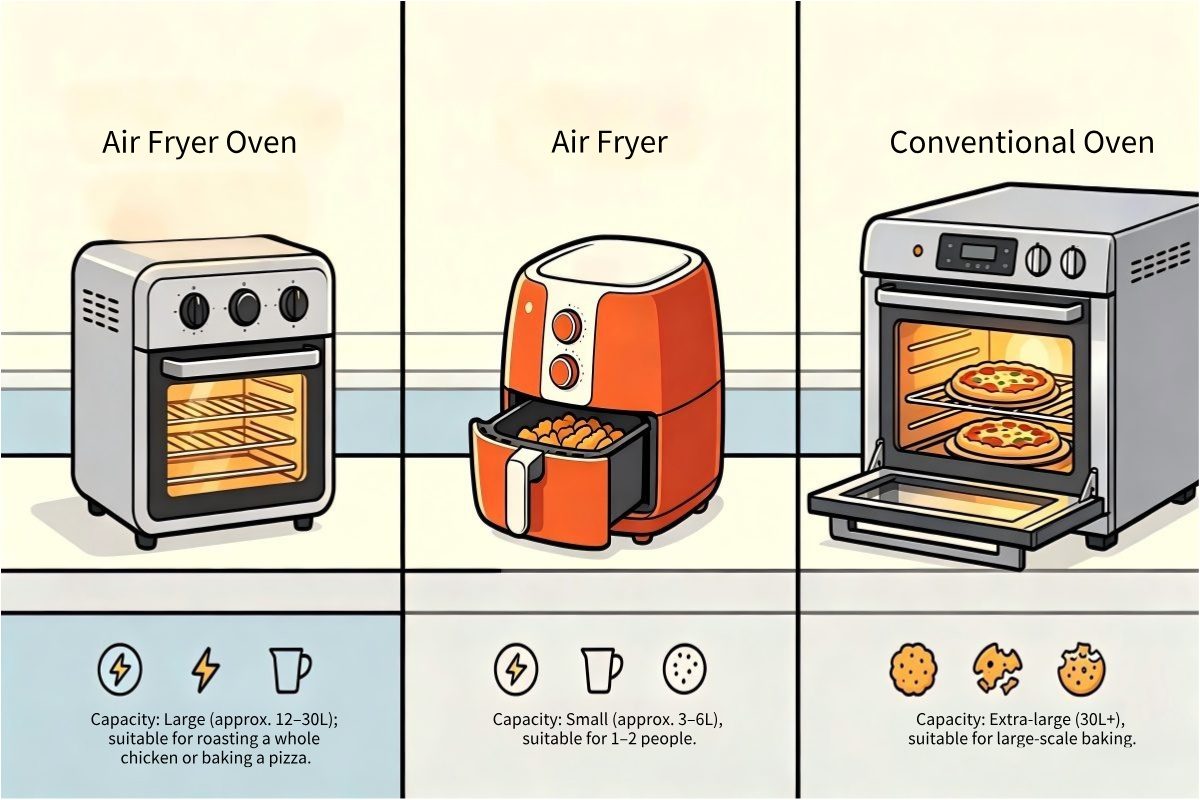
Table of Contents
1. Meet the Three Contenders
Air Fryer: The Quick-Hit Specialist
An air fryer works simply – a heating element at the top plus a high-speed fan circulates hot air rapidly inside a small enclosed space, mimicking the effect of deep frying. It creates a crispy outer layer on food with little to no oil.
The air fryer’s biggest advantage is speed. Preheating takes only 3–5 minutes, and chicken wings at 180°C are done in about 15 minutes. It’s compact, doesn’t take much counter space, and has a very low learning curve – even a complete beginner can make a decent meal within an hour.
However, the downsides are clear – limited capacity. Most are only 3–5 litres, so you can’t cook large portions or roast a whole chicken. Also, air fryers only have a heating element on top, so thicker foods can end up burnt on top and undercooked on the bottom – you’ll need to flip them halfway. And forget about professional baking like chiffon cakes or bread loaves – it’s just not designed for that.
Best for: 1–3 person households, singles, busy professionals, and anyone looking for quick, low‑oil meals. Budget: around $30–100 USD.
Oven: The Baking Pro
Traditional ovens rely on top and bottom heating elements that radiate heat. Their core strengths are precise temperature control and generous capacity.
Good ovens offer independent top/bottom temperature control with accuracy within ±5°C. Capacities usually start at 20 litres and can go up to 40 litres or more. Roast a whole chicken, bake pizza, cakes, or bread – they handle it all. Many models also include a low‑temperature fermentation mode (40–50°C) for making yoghurt or proofing dough.
But ovens have obvious drawbacks – slow preheating and large footprint. Reaching 200°C can take 10–15 minutes, and they’re bulky and heavy – a small kitchen may not have room. Cleaning is also more cumbersome compared to air fryers.
Best for: Families of 3+, baking enthusiasts, and anyone who makes complex baked goods regularly. Budget: entry-level around $70–140 USD, pro models can go over $700.
Air Fryer Oven: The Best of Both Worlds
An air fryer oven combines the features of both – it has top and bottom heating elements (some with independent control) plus the high‑speed fan needed for air frying.
Capacity sits in the middle, usually between 15 and 30 litres. It handles the low‑oil dishes that air fryers excel at, while also covering the baking capabilities of a traditional oven. One machine replaces several devices – air fryer, oven, dehydrator, and proofing box all in one.
In terms of texture, because heat comes from both top and bottom plus circulating hot air, food cooks more evenly – chicken wings come out golden on both sides without flipping. The crispy exterior and tender interior are nearly identical to what you get from an air fryer.
That said, it’s not perfect – more functions mean it’s larger than an air fryer and pricier. Entry-level models run about $40–85 USD, mid‑to‑high end $85–170 USD.
Best for: 2–4 person households, those with limited kitchen space who want a multi‑function device, and people who want both low‑oil meals and occasional baking.
2. At a Glance: Comparison Table
| Feature | Air Fryer | Oven | Air Fryer Oven |
|---|---|---|---|
| Working principle | Top heating element + high‑speed fan, hot air circulation | Top & bottom heating elements, radiant heat | Top & bottom heating elements + high‑speed fan, both combined |
| Capacity | 3–5 L | 20–40 L+ | 15–30 L |
| Preheat time | 3–5 min | 10–15 min | 5–8 min |
| Best for | Fries, wings, reheating frozen snacks | Cakes, bread, pizza, whole chicken | Both sides |
| Need to flip food? | Thicker items require flipping | Generally no | Rarely needed |
| Counter space | Very small | Large | Medium |
| Cleaning effort | Easy | More involved | Moderate |
In terms of size: oven > air fryer oven > air fryer. Price follows the same order. For versatility, the oven ranks first, then the air fryer oven, with the air fryer being the most specialised. For convenience, the air fryer and air fryer oven are about equal, both ahead of the traditional oven.
3. How to Choose – Three Scenarios
Scenario 1: Living alone or as a couple, speed and convenience matter most
Go for an air fryer. It’s compact, easy to use, and fast – perfect for wings, fries, and healthy meals. The price is low, so it won’t break the bank.
Scenario 2: You’re a baking enthusiast or have a large family
Choose a traditional oven. You need precise temperature control and ample capacity. An air fryer won’t give you a fluffy chiffon cake or fit a large pizza or whole chicken. Don’t try to cut corners here – the oven is what you really need.
Scenario 3: You want to try a bit of everything, but your kitchen isn’t huge
Pick an air fryer oven. This is currently the smartest choice – you get the functionality of both an air fryer and an oven for the price and footprint of one machine. You can make low‑oil dishes and occasionally bake cakes or bread, without agonising over “which one to buy”. Market trends in 2026 show more and more people leaning towards air fryer ovens.
4. If You Decide on an Air Fryer Oven – Key Buying Tips
- Heating configuration: Prioritise models with independent top/bottom temperature control – that’s what gives you real baking capability.
- Temperature range: A low end of 40–50°C is useful for fermentation; a higher maximum temperature speeds up roasting.
- Wattage: Look for 1600W or above for better heating efficiency.
- Capacity: Choose based on your household size – 15–20L for 2–3 people, 25L+ for 4 or more.
- Material: Go for an enamel or non‑stick interior coating – it makes cleaning much easier.
Final Verdict
None of these three is inherently “better” – it all comes down to your actual needs.
- Air fryer: Specialises in speed – great for small families and quick meals.
- Oven: Specialises in precision – perfect for baking lovers and larger households.
- Air fryer oven: Balances both – ideal for most families who want a single versatile appliance.
If you have plenty of kitchen space and a generous budget, owning both an air fryer and an oven is ideal. But if counter space is tight and you want to enjoy both cooking styles, the air fryer oven is probably the most worthwhile investment right now.
I hope this guide helps you make the right decision. Feel free to leave a comment below if you have any questions – I’d love to hear from you!
