
Let’s be honest — launching an air fryer oven on time is harder than it looks.
Most OEM project delays are preventable. Yet they keep happening. Brand owners, procurement managers, and product developers pour months of work into a new kitchen appliance project, only to watch the launch date slip week after week. The container misses the seasonal sales window. Retailers get impatient. Marketing campaigns go live with no product to sell. And the factory says “sorry” while you absorb the cost.
The pattern is so common it’s almost predictable — but it doesn’t have to be.
This article explains the most common causes of OEM project delays and provides practical, battle-tested methods to keep your air fryer oven project moving from concept to mass production on schedule.
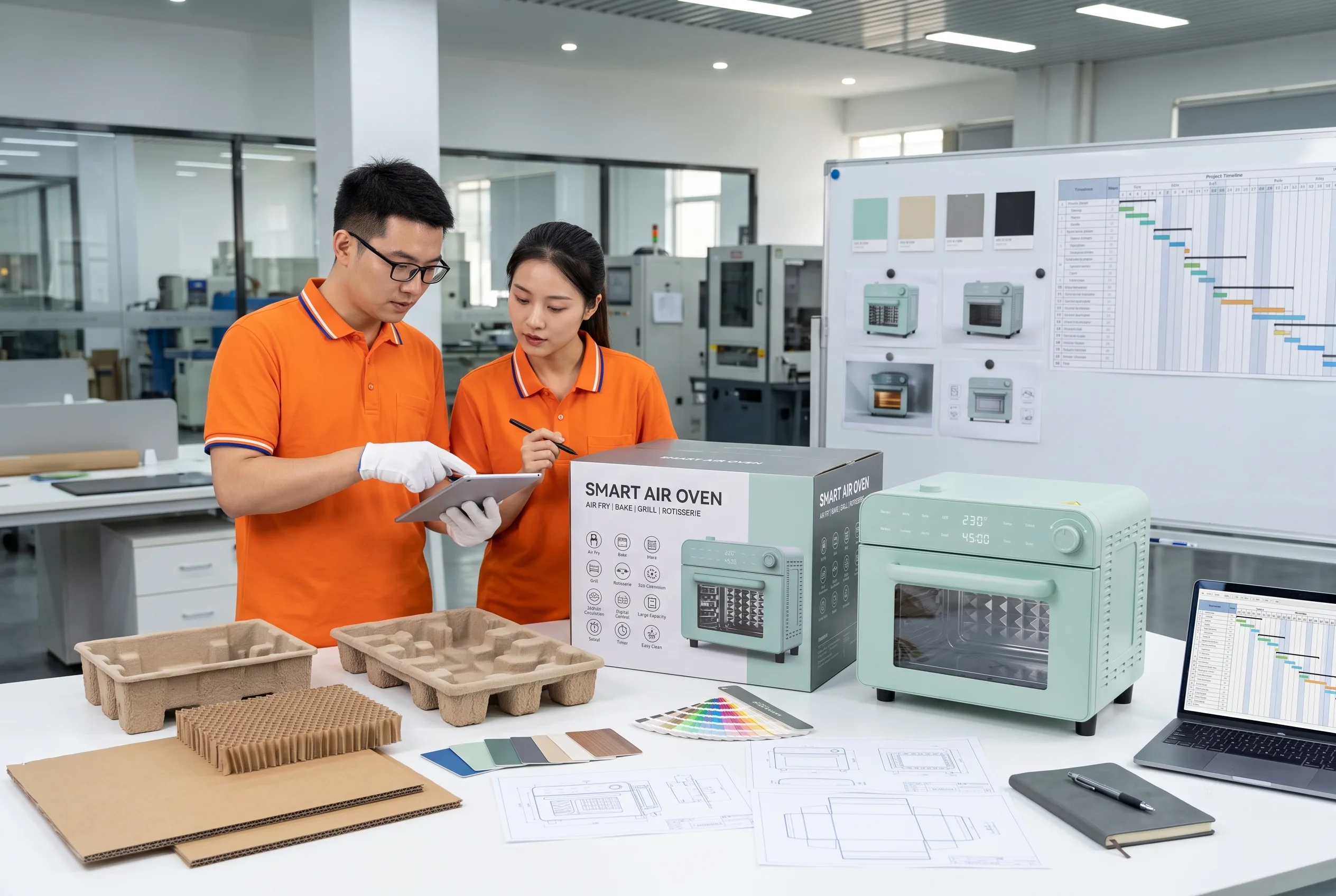
Table of Contents
1. Why OEM Kitchen Appliance Projects Are Often Delayed
OEM appliance projects involve many connected stages: design confirmation, engineering evaluation, tooling, sampling, testing, packaging, material preparation, and mass production. If one stage is unclear or delayed, the entire schedule unravels.
Common delay causes include:
- Incomplete product requirements
- Late-stage design changes
- Tooling modifications
- Certification issues
- Long material lead times
- Delayed packaging confirmation
- Slow communication between buyer and supplier
But here’s the deeper truth: most delays are not technical problems — they are process problems. They happen because decisions get made too late, because information gets lost in translation, because someone assumed something that wasn’t true.
Understanding these risks early allows both sides to build a more realistic schedule and avoid unnecessary rework.
2. Confirm Product Requirements Early — And I Mean Really Early
Clear product requirements are the foundation of an on-time OEM project. Before development starts, both sides should lock in the capacity, product dimensions, function list, control system, appearance direction, accessory configuration, certification requirements, MOQ, and target shipment date.
For air fryer oven projects, this means documenting specifics: 12L, 16L, or 30L capacity; mechanical knob, digital, or IMD control panel; cooking modes; surface finish; packaging requirements.
A complete project brief helps the factory evaluate feasibility, prepare resources, and reduce later misunderstandings.
But here’s where most projects go wrong:
Brand owners often approach a factory with a vague brief — “we want a nice air fryer” — and expect the factory to fill in the blanks. The factory makes assumptions. Those assumptions become design decisions. Those decisions become tooling. And when the brand owner finally sees the product, they say “that’s not what I wanted.”
The fix: Bring reference images. Bring competitor products you admire. Bring a detailed spec sheet — even if it’s rough. The more specific you are upfront, the fewer surprises you’ll have later.
As one industry guide notes, vague or conflicting product requirements are among the most common causes of product development delays. Product requirements that aren’t well defined lead to system interfaces that don’t align, firmware features that are improperly implemented, and components that fail to meet performance expectations.
3. Avoid Unnecessary Late-Stage Changes — Or Pay the Price
Late-stage changes are one of the biggest causes of project delays. Changes made after tooling or sample approval may require structural revision, new parts, extra testing, and additional cost.
Before tooling begins, key elements such as control panel design, door structure, handle design, internal cavity structure, heating layout, and packaging direction should be carefully reviewed and approved.
If a change is necessary, it should go through a formal change request process. The factory should evaluate its impact on cost, tooling, testing, certification, and delivery timeline before implementation.
The hidden cost of “just one more change”:
Research shows that engineering changes often continue well into later phases of product development rather than declining after prototype validation. This pattern is so common it has a name: design creep. Each change seems small — “just move this button,” “just adjust this angle” — but they compound. Each change triggers a cascade of downstream impacts: revised CAD, updated BOM, new sample, retesting, recertification.
The fix: Freeze the design at the right time. Distinguish between critical fixes (things that affect safety or functionality) and non-essential modifications (things that are “nice to have”). Save the nice-to-haves for Version 2.
A single misstep in the process or a misunderstanding of design intent can create delays or quality issues that derail a major project. Once a design is frozen and tooling has begun, even a minor interference issue can delay a project by weeks — or require an entirely new mold.
4. Plan Testing and Certification Time Properly — It Takes Longer Than You Think
Testing is often underestimated in OEM projects. A realistic schedule should allow enough time for cooking performance tests, temperature uniformity tests, surface temperature checks, reliability testing, electrical safety evaluation, and customer sample review.
For international markets, certification requirements such as UL, ETL, CE, or other regional standards may also require additional time. If testing is rushed, the project may face repeated failures and longer delays later.
A professional project plan should include testing buffer time and clear responsibilities for sample preparation, test data review, and certification document support.
The certification trap:
Many brand owners assume certification is a simple checkbox — send a sample to a lab, get a certificate, done. In reality, certification is a process that can take weeks or months. Testing failures require redesign and retesting. Documentation must be prepared and reviewed. Labs have backlogs.
Some factories try to expedite by conducting internal testing and “self-certifying.” This is a dangerous shortcut. If your product fails a third-party audit or causes a safety incident, the liability falls on your brand — not the factory.
The fix: Build certification time into the project plan from Day 1. Ask your factory which certifications they already hold and which will require new testing. Get a realistic timeline from an accredited lab. And never ship product without proper certification — the cost of a recall is far higher than the cost of doing it right.
5. Manage Packaging and Documentation in Parallel — Not at the End
Packaging and documentation should not wait until the end of product development. Color box design, user manuals, rating labels, certification marks, barcodes, shipping marks, warranty cards, and instruction materials should be prepared in parallel with sample and testing work.
This approach allows packaging printing and documentation review to start earlier, saving valuable time before mass production shipment. For brand owners, early packaging confirmation also helps maintain consistent retail presentation and reduce last-minute artwork errors.
The packaging trap:
Here’s a common scenario: the product is ready. Production is complete. The container is booked. And then someone realizes the packaging artwork hasn’t been approved. The printing takes two weeks. The container waits. Demurrage charges pile up.
This happens because packaging is treated as an afterthought — something to figure out “when we get there.” But packaging is just as complex as product development: artwork revisions, color matching, material sourcing, print lead times, regulatory label requirements.
The fix: Start packaging design at the same time as product development. Confirm all packaging artwork before production starts. Treat packaging as a parallel workstream, not a final step.
6. Pay Attention to Material Lead Times — The Hidden Bottleneck
Component sourcing is one of the most underestimated delay factors in OEM projects. Many OEMs plan their time-to-market strategy around design readiness and manufacturing capacity, but the biggest delays often stem from issues hidden much earlier: component quality, sourcing visibility, supplier performance, and lack of transparency across the material flow.
When a component problem appears during pilot builds, validation builds, or ramp-up, it creates a chain reaction: investigation, root-cause analysis, containment, supplier response, rework or redesign, additional testing, rescheduling the build. What should be a two-day issue turns into a two-week delay.
Early material issues create major time-to-market delays because they affect not just the immediate build but every subsequent stage. If you receive materials that don’t match design intent, or inconsistent quality across lots, or unverified supplier alternatives, any one of these issues can halt an entire production line.
Some contract manufacturers compromise on quality by using cheap materials, which leads to erratic product quality and production delays. A lack of technical know-how may cause manufacturers to skip steps that result in inferior quality — which is why OEMs must ensure the contractor is adequately staffed with technical experts.
The procurement trap:
Many brand owners assume the factory handles all sourcing and that materials are always available. This is not true. Some components have long lead times — 8, 12, or even 20 weeks for specialized parts. If a critical component isn’t ordered early enough, the entire production schedule shifts.
Some factories also fail to qualify suppliers upfront or validate components before usage. This means problems don’t surface until the component is already on the production line.
The fix: Ask your factory for a list of critical components and their lead times early in the project. Order long-lead items as soon as the BOM is stable. Qualify suppliers and validate components before mass production. And maintain a watchlist for critical-path parts with buffer buys tied to engineering gates.
7. Work with a Factory That Has Strong Project Management Experience
Ultimately, the biggest factor in on-time delivery is the factory’s project management capability. A factory with strong project management experience will:
- Set clear milestones and track progress against them
- Flag risks early rather than hiding them
- Maintain transparent communication throughout development and production
- Have a structured change request process
- Build buffer time into the schedule
- Keep inspection records for traceability and continuous improvement
What to look for in a factory partner:
- Dedicated project management staff, not just a salesperson
- Technical experts who can evaluate design feasibility
- State-of-the-art equipment and processes
- A history of on-time delivery (ask for references)
- Transparent communication — they tell you about problems before they become crises
The red flags:
- “Don’t worry, we’ll figure it out later” (no, you won’t)
- Vague timelines and milestones
- No written project plan
- Slow response to emails or questions
- Resistance to sharing test data or inspection reports
Partnering with an experienced manufacturer can make the difference between a delayed launch and the successful delivery of a product that meets both performance and design expectations.
Why Structured Project Management Matters
A structured development process is not bureaucratic overhead — it is risk management.
Without clear phases, gates, and approvals, projects drift. Requirements change mid-stream. Prototypes get approved without proper testing. Tooling is cut based on incomplete designs. And the result is expensive rework, delayed launches, or worse — a product that fails in the market.
Common failure points in unstructured projects:
- Undefined requirement changes mid-tooling. Adding functions after molds are cut is expensive and delays production.
- Skipped prototype validation. Going straight from concept to mass production is the fastest way to discover design flaws after thousands of units are built.
- Insufficient testing. A product that passes basic functional checks but hasn’t undergone durability or safety certification is not ready for market.
- No pilot run. The first full production batch becomes the de facto pilot run — meaning any process issues get amplified across all units.
A professional OEM partner structures development to avoid these traps. They will not let you skip steps, even when you are in a hurry. That is not inflexibility — that is protecting your investment.
How LINDEN Supports On-Time Project Delivery
At Foshan Linden Intelligent Appliances Co., Ltd., we understand that time-to-market is critical for brand success. Our structured project management approach helps clients avoid common delays and bring products to market faster.
Our project management strengths include:
- Clear milestones and transparent communication. We provide regular production updates, inspection reports, and sample approvals — no surprises.
- Early requirement alignment. We help clarify target market, capacity, functions, and certification needs before any design work begins.
- Structured change management. If a change is necessary, we evaluate its impact on cost, tooling, testing, certification, and delivery before implementation.
- Parallel workstreams. Packaging, documentation, and certification preparation run alongside product development — not after it.
- Material lead-time management. We identify long-lead components early and order them as soon as the BOM is stable.
- In-house testing and certification support. Our products are certified for international markets including ETL/UL for North America and CE/GS, CB, RoHS, REACH, LFGB for Europe and other regions.
- Quality control throughout production. IQC, IPQC, and FQC inspection systems with documented checkpoints at every stage.
Whether you are launching a new brand, expanding an existing product line, or developing a private label program, our team provides tailored support from concept through mass production — with the goal of getting your product to market on time.
Conclusion
OEM project delays are common — but they are not inevitable. Most delays are caused by process failures, not technical failures: vague requirements, late changes, underestimated testing timelines, packaging that starts too late, materials that arrive too slowly, and factories that don’t manage the project well.
The good news is that every one of these issues is preventable. Clear requirements upfront. A disciplined approach to design changes. Realistic testing and certification timelines. Parallel packaging development. Early material planning. And a factory partner with strong project management experience.
For brand owners and procurement managers, the key takeaway is this: a structured development process protects your investment. It reduces the risk of expensive rework, prevents certification failures, and ensures that when your product reaches customers, it works as promised — and arrives on time.
The right OEM partner does not just manufacture components. They guide you through each stage, flagging risks early, validating thoroughly, and maintaining quality across every batch. That is the difference between a product launch you are proud of and one you spend months trying to fix.
