
Uneven cooking in air fryer ovens usually comes down to a combination of airflow, heating-element output, temperature control, food placement, and cooking load. One side of a tray may brown too quickly while another remains pale, or the upper rack may finish cooking long before the lower rack. These problems frustrate consumers, but for appliance brands and manufacturers, they can also lead to product complaints, poor reviews, warranty claims, and higher return rates.
The challenge is that uneven cooking does not always indicate a faulty heating element. A perfectly functional oven can produce inconsistent results if its fan, cavity geometry, rack spacing, accessories, and control system do not work well together. The more useful question is not simply whether an oven gets hot enough, but whether it delivers the right amount of heat to different foods and positions throughout the cooking cycle.
For product development teams, understanding these variables helps distinguish user-related cooking problems from design limitations and manufacturing defects. It also provides a practical framework for evaluating an air fryer oven before approving a production sample or placing a bulk order.
How Does an Air Fryer Oven Cook Food, and Why Does Heat Distribution Matter?
An air fryer oven combines heating elements with a fan-driven convection system. The heating elements supply thermal energy, while moving hot air transfers heat to the food surface. Heat also travels through the food toward its center, so the final result depends on more than the oven’s displayed temperature.
Three mechanisms work together:
- Convection: Moving hot air transfers heat to the food surface and helps remove the cooler, moist air surrounding it.
- Radiation: Heating elements and hot internal surfaces radiate energy toward exposed food surfaces.
- Conduction: Heat moves through the food and through contact points, such as where a potato rests against a tray.
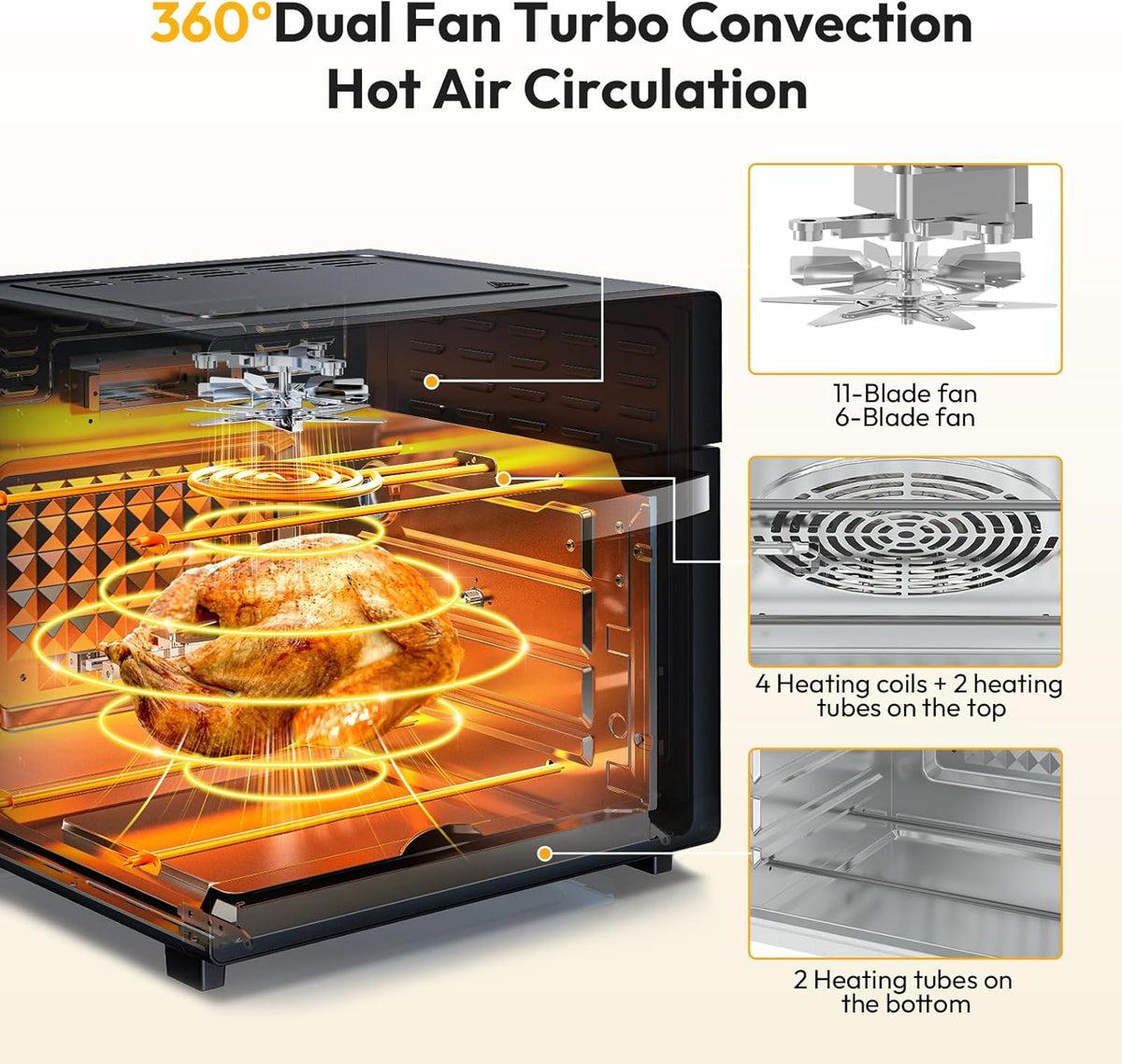
The balance between these mechanisms changes with the food, cooking mode, rack position, and appliance design.
For example, a thin potato slice exposed to fast-moving hot air can brown quickly, while a thick chicken breast may develop a browned exterior before the center reaches its target temperature. A baking tray can also shield the food underneath it from direct airflow or radiation.
This is why a single temperature reading cannot fully describe cooking performance. An oven may reach its set temperature while still producing noticeable differences in browning, crispness, and cooking time across its usable space.
For manufacturers, the objective is to design a system that delivers repeatable results under defined loading conditions, not merely to demonstrate that the heating elements can reach a specified temperature.
What Are the Main Causes of Uneven Cooking in Air Fryer Ovens?
1. Poor Airflow Distribution Inside the Cooking Cavity
Airflow is one of the first variables to investigate when food cooks unevenly. The fan may move a substantial volume of air, yet that air will not necessarily reach every part of the cavity at the same velocity or temperature.
The internal arrangement determines how air travels from the fan and heating elements around the food and back through the circulation path.
Several design factors can interfere with this process:
- Fan diameter, blade geometry, speed, and motor performance.
- The location of the fan relative to the heating elements.
- The shape and dimensions of the cooking chamber.
- Air inlet and return-path restrictions.
- Rack supports, trays, and accessories that obstruct circulation.
Consider an oven in which the airflow reaches the center of the upper rack more effectively than the rear corners of the lower rack. Foods in the center may brown quickly, while food near the corners requires more time.
Increasing the fan speed is not necessarily the best solution. Higher airflow can increase noise, affect energy consumption, and cause lightweight food or loose coatings to move. The more effective approach is to assess the entire airflow path and determine whether the fan, cavity, and rack arrangement are properly matched.
During product development, engineers can use temperature mapping, airflow visualization, and controlled cooking tests to identify weak circulation zones. These methods help reveal whether the problem originates in the fan system or in the way air moves through the assembled oven.
2. Uneven Heating from the Heating Elements
Heating elements supply the energy that maintains the cooking environment. Their position, output, geometry, and control behavior influence how heat reaches the food.
An upper element may brown the exposed surface rapidly, especially when food sits close to it. Meanwhile, the underside may remain pale if it receives less direct radiation and has limited contact with a hot surface.
The opposite problem can occur when the lower element supplies substantial heat to a tray while the upper surface receives less energy. The food may cook through but fail to develop the expected color and crispness.
Manufacturers should assess several factors:
- Element placement and the distance between elements and food.
- Heat output under different operating modes.
- Temperature differences between the upper, middle, and lower cavity.
- Recovery after the door is opened.
- Cycling behavior when the controller switches the heating elements on and off.
The number of heating elements alone does not determine performance. Two elements positioned poorly can produce worse results than a carefully engineered configuration with fewer elements.
The key is to match the heating layout to the intended cooking tasks. Air frying, baking, roasting, and dehydrating have different requirements, so a multifunctional appliance needs to balance competing thermal demands.
3. Incorrect or Inconsistent Temperature Control
A temperature setting is a control target, not a guarantee that every point inside the oven remains at exactly that temperature.
Most conventional control systems regulate heating according to readings from one or more sensors. The measured temperature represents the sensor’s local environment, which may differ from the conditions around food on another rack.
Uneven cooking can result from several issues:
- Sensor placement that does not adequately represent the cooking cavity.
- Sensor tolerances or calibration errors.
- Excessive temperature overshoot after heating begins.
- Control algorithms that allow large temperature swings.
- Slow recovery after the door opens or cold food is loaded.
For example, the sensor may reach the target temperature while a heavily loaded lower rack is still recovering from the addition of cold food. The controller can therefore report normal operating conditions even though the cooking process remains uneven.
The USDA Food Safety and Inspection Service’s guidance on appliance thermometers explains how an oven thermometer can be used to check whether an oven heats to its intended temperature. For product testing, temperature measurements should be taken at multiple locations rather than relying exclusively on the display.
Better control algorithms can reduce overshoot and improve temperature stability. However, software cannot fully correct a fundamentally poor airflow path or an inadequately designed heating system.
4. Overloading the Oven or Blocking Airflow
Food placement is a common cause of uneven cooking, even when the appliance is operating normally.
When food pieces overlap or sit too close together, they obstruct airflow and create sheltered surfaces. Moisture released during cooking can also accumulate around crowded food, slowing surface drying and browning.
The same issue occurs when users place solid baking trays or oversized accessories in positions that block the intended circulation path.
A practical example is a tray of frozen fries. Fries arranged in a single layer with space between pieces expose more surface area to moving hot air. When the same fries are piled together, the outer pieces may brown while the pieces in the middle remain soft.
The solution depends on the cooking task:
- Use an appropriate single-layer arrangement when crispness is the priority.
- Leave sufficient space between food pieces for air to circulate.
- Avoid covering perforated trays or air-fry baskets with solid liners unless the appliance instructions specifically allow the arrangement.
- Follow the manufacturer’s loading guidance for each rack and accessory.
For appliance manufacturers, loading instructions should be developed alongside performance testing. A product should not be evaluated only with a lightly loaded tray if its intended market expects consumers to cook larger portions.
5. Rack Position and Multi-Level Cooking
Rack position can significantly affect cooking results in an oven-style air fryer because different levels receive different combinations of convection, radiation, and conductive heat.
An upper rack closer to a heating element may brown food faster. A lower rack may experience different airflow or receive more heat from a lower element. When multiple trays are installed, the upper tray can also shield the tray below it.
These differences become more noticeable when users cook several kinds of food simultaneously.
For example, a tray of thin vegetables on the upper rack may finish before thicker pieces of chicken on the lower rack. The result is not necessarily a defect; the foods have different thermal requirements, and their positions expose them to different heating conditions.
However, large, unpredictable differences between rack positions can indicate a design or control problem.
During validation, manufacturers should test the oven with:
- A single tray at each approved rack position.
- Multiple trays loaded simultaneously.
- Identical food samples placed at different positions.
- Representative minimum and maximum loads.
This helps determine whether the appliance provides acceptable consistency across its intended operating range.
6. Food Size, Moisture, and Starting Temperature
Not every difference in cooking results originates in the appliance.
Food itself introduces variation. Pieces of different thicknesses have different heating times, while moisture content affects surface drying and browning. Frozen food also requires additional energy to warm and thaw before its temperature can rise substantially.
A thick piece of chicken may remain undercooked in the center even when its exterior is golden. Small potato cubes may brown rapidly while larger cubes remain firm. Vegetables with high water content may soften before developing a crisp surface.
These differences matter when comparing cooking performance between product samples.
To isolate the oven’s contribution, engineers should standardize food dimensions, initial temperature, mass, moisture condition, and tray arrangement. Otherwise, differences in the test material may be mistaken for differences in appliance performance.
7. Door Opening, Heat Loss, and Insulation
Opening the door allows hot air to escape and introduces cooler air into the cavity. The resulting temperature disturbance depends on the oven’s design, operating conditions, and duration of the opening.
Frequent checks can extend cooking time, particularly when the oven needs time to recover. Door sealing and insulation also affect heat retention, although they do not independently guarantee uniform cooking.
For manufacturers, relevant variables include door alignment, gasket design where applicable, glass construction, cavity insulation, and the controller’s response to temperature changes.
A viewing window and interior light can help users inspect progress without repeatedly opening the door. These features improve convenience, but their value depends on how effectively they support the cooking process.
8. Fan, Sensor, or Assembly Problems
Uneven cooking can also be a symptom of a manufacturing defect rather than an inherent design limitation.
Possible causes include a fan motor operating below its intended performance, an incorrectly installed sensor, inconsistent heating-element connections, or assembly variation that changes clearances and airflow.
These problems should be investigated when an oven performs inconsistently under the same test conditions or when performance deteriorates between production batches.
A useful diagnostic distinction is whether the unevenness is repeatable:
- If the same locations consistently cook faster, the pattern may indicate a design-related heat or airflow distribution issue.
- If results vary significantly between nominally identical units, component variation or assembly quality deserves closer inspection.
- If unevenness appears mainly under heavy loading, the loading limits or multi-rack performance may need further evaluation.
This distinction helps prevent unnecessary redesign when the real problem is manufacturing consistency—or unnecessary component replacement when the underlying issue is the cavity design.
How Can You Identify the Cause of Uneven Cooking?
The most efficient troubleshooting process begins by describing the pattern rather than immediately changing the temperature or fan setting.
The table below connects common symptoms with likely causes and appropriate verification methods.
| Observed symptom | Likely cause | Recommended check |
|---|---|---|
| Food browns faster at the top | Proximity to the upper element or uneven vertical heat distribution | Compare results across rack positions |
| Center cooks faster than corners | Uneven airflow or localized heating | Map temperatures and compare food samples by position |
| Food is browned outside but undercooked inside | Food thickness, excessive surface heating, or insufficient cooking time | Measure internal food temperature and standardize piece size |
| Fries cook unevenly in a full tray | Overloading, overlapping pieces, or restricted airflow | Repeat the test with a single layer and controlled spacing |
| Results vary between identical ovens | Sensor, fan, heating-element, or assembly variation | Compare units using the same standardized test |
| Cooking takes longer after opening the door | Heat loss and temperature recovery behavior | Record temperature recovery under repeatable conditions |
| Upper rack cooks well but lower rack remains pale | Rack shielding or uneven multi-level airflow | Compare single-rack and multi-rack performance |
These are diagnostic starting points, not definitive diagnoses. Several causes can produce similar symptoms, so controlled testing is necessary before a manufacturer changes the design or replaces a component.
A Practical Test for Heat Distribution
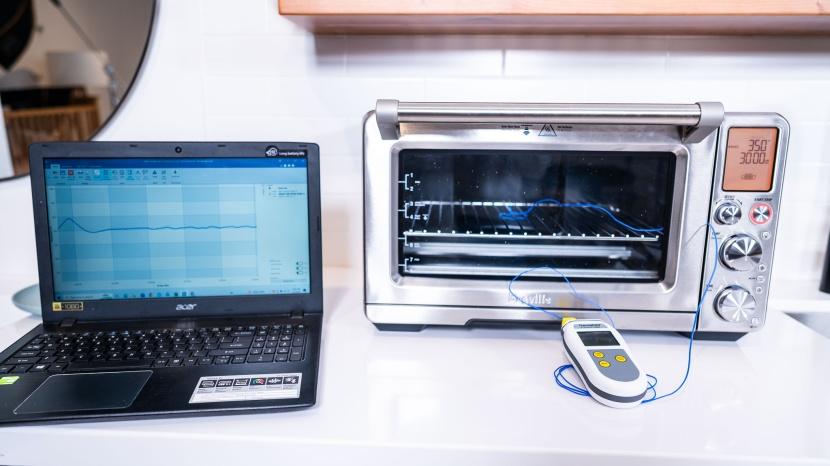
A repeatable cooking test is often more informative than a general claim that an oven heats evenly.
Start by preheating the appliance according to its operating instructions. Use identical food samples or another suitable standardized test load, and record the placement of every sample.
Next, measure temperatures at representative locations, including the center, corners, and different rack levels. Where food performance is the main concern, record browning, surface texture, internal temperature, and cooking time as well.
Repeat the test under the same conditions. Then change one variable at a time, such as rack position, load size, or fan setting, to identify which factor has the greatest influence.
For electrical appliance development, temperature probes and calibrated data loggers can reveal patterns that a single oven thermometer may miss. Food-based tests remain useful because a uniform air temperature does not necessarily translate into uniform browning or crispness.
The test protocol should also define acceptable variation before testing begins. Otherwise, teams may disagree about whether a result is acceptable simply because they have not established a common performance target.
Which Air Fryer Oven Design Factors Have the Greatest Effect on Cooking Consistency?
For appliance brands comparing OEM or ODM suppliers, the most useful question is which design choices have a measurable effect on cooking performance—and which specifications simply look impressive on a product sheet.
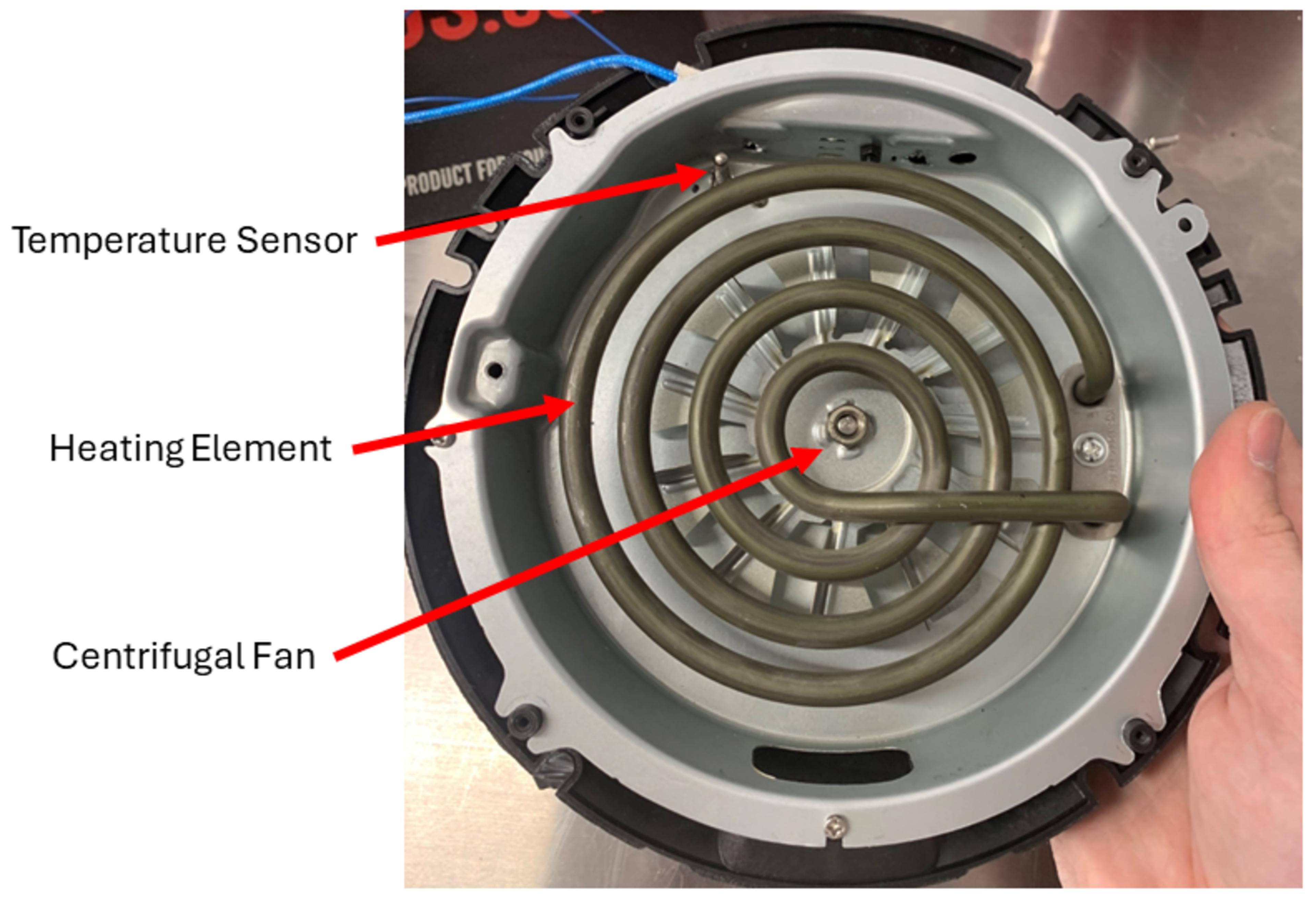
The following comparison highlights the trade-offs that product development teams should examine.
| Design factor | What it influences | Potential trade-off | What buyers should verify |
|---|---|---|---|
| Fan and airflow path | Air circulation and surface heat transfer | Higher airflow can increase noise and affect lightweight foods | Airflow distribution and cooking results at different positions |
| Heating-element layout | Surface browning and heat delivery | Strong top heat may brown exposed surfaces too quickly | Top-to-bottom cooking consistency |
| Temperature sensor placement | How accurately the control system represents cavity conditions | One sensor cannot directly measure every cooking zone | Temperature mapping and control response |
| Rack spacing | Air access and exposure to heating elements | More rack levels do not automatically mean better simultaneous cooking | Single-rack and multi-rack test results |
| Cavity capacity | Available cooking space and usable load | A larger chamber can introduce more complex airflow requirements | Performance at representative loading levels |
| Control algorithm | Temperature stability and response to changing conditions | Aggressive correction may produce overshoot or cycling | Temperature traces and repeatability across test cycles |
A useful principle emerges from this comparison: larger capacity, higher fan speed, and more cooking presets do not automatically produce more consistent food. The performance of the complete system matters more than any single specification.
For example, a 16-liter oven with three rack positions may offer more flexibility than a smaller appliance with two levels. However, the extra rack position only adds value if the airflow and heating system can support the intended cooking load.
The Linden AE1606 convection oven air fryer illustrates the type of platform buyers can evaluate against these requirements. Its published specifications include a 16-liter capacity, 1,400 W rated power, three rack positions, digital control, and a maximum temperature of 230°C (450°F). These specifications describe the platform, but buyers should request cooking-test evidence before drawing conclusions about actual heat uniformity.
Why Capacity and Wattage Should Be Evaluated Together
Rated power indicates the electrical power consumed under specified operating conditions; it does not directly measure how evenly that energy reaches food.
Two ovens with similar rated power can perform differently because of differences in cavity dimensions, insulation, fan characteristics, element placement, and control behavior.
Likewise, a larger cavity can accommodate more food but may require a different airflow and heating arrangement to maintain comparable cooking performance.
A compact model such as the Linden KA1211 12-liter air fryer oven has a published rated power of 1,400 W and two rack positions. Buyers evaluating compact appliances should focus on the usable cooking area, expected food load, and intended cooking modes rather than assuming that the smaller chamber will automatically eliminate hot spots.
For a larger countertop convection oven, the same principle applies. The AA3001 countertop convection oven provides another platform for assessing how capacity, rack configuration, heating design, and intended applications should align. The exact specifications and performance claims should be confirmed against the current production specification sheet.
How Should Manufacturers Test and Control Heat Distribution?
For a B2B buyer, an attractive prototype is not enough. The supplier needs to demonstrate that the design can deliver repeatable performance and that production units remain consistent with the approved sample.
A structured quality-control process should cover three stages.
1. Design Validation
Design validation determines whether the oven meets its intended cooking requirements.
Testing should cover representative foods and operating modes, including air frying, baking, and roasting where applicable. Engineers should assess temperature distribution, cooking time, browning, and internal food temperature under controlled conditions.
Testing only one food type at one temperature is insufficient to characterize a multifunctional appliance. A design that performs well with thin fries may behave differently when baking a dense product or cooking several trays simultaneously.
For OEM and ODM projects, buyers should agree on the test conditions and acceptance criteria before design approval. This prevents disputes later over what constitutes acceptable performance.
2. Production Quality Control
Once the design is approved, production QC should check whether each unit is built to the intended specification.
Relevant checks may include:
- Heating-element installation and electrical connections.
- Fan operation and motor performance.
- Sensor placement and temperature-control response.
- Door alignment and sealing.
- Rack and tray fit.
- Functional testing of each cooking mode.
- Repeatable performance checks on an agreed sample of finished units.
The exact inspection plan should reflect the product’s risk level, production volume, and buyer requirements. Not every factory needs to perform a complete thermal mapping test on every finished unit, but the supplier should have a defensible process for verifying that production remains consistent.
3. Batch Consistency and Corrective Action
If one production batch produces more uneven cooking than the approved sample, the supplier should investigate the underlying cause rather than immediately adjusting the temperature setting.
A useful corrective-action process records the affected model and batch, test conditions, observed failure pattern, suspected cause, corrective measure, and results of repeat testing.
This creates a traceable link between product performance and manufacturing decisions.
For importers and private-label brands, the commercial benefit is straightforward: identifying a repeatable defect before shipment is generally easier to manage than dealing with complaints after products reach retail customers.
What Should B2B Buyers Ask an Air Fryer Oven Manufacturer Before Ordering?
Uneven cooking is not always visible during a short product demonstration. Buyers should therefore include performance requirements in the technical evaluation and quotation process.
Before approving a sample or requesting a quotation, clarify the following points.
Cooking Performance
Ask whether the manufacturer has temperature-distribution data and cooking tests for the proposed model. Request details about the food load, rack positions, operating mode, and test conditions.
If the product is intended for several markets, check whether the test setup reflects the voltage, frequency, and operating conditions of the version being purchased.
Product Configuration
Confirm the capacity, rack count, heating-element arrangement, fan system, control type, temperature range, and accessories included in the quotation.
If your brand requires a customized control panel or cooking presets, determine whether the supplier can validate the revised configuration rather than relying solely on results from a different platform.
Quality Standards and Acceptance Criteria
Agree on the performance criteria that matter to your product positioning. These might include repeatability between units, acceptable temperature variation, cooking time, surface browning, or internal food temperature under defined conditions.
Do not assume that the phrase “even heating” has the same technical meaning for every supplier. Ask how the manufacturer measures it and what evidence is available.
Sampling and Mass Production
Confirm whether the approved sample represents the intended production configuration, including the fan, heating elements, sensor, software, accessories, and enclosure.
Ask how the factory checks production units, how it handles failed tests, and how changes to components or suppliers are controlled.
A change to a fan motor or sensor can affect performance even if the model number remains unchanged. Buyers should understand how the manufacturer prevents unapproved substitutions from undermining the approved specification.
A Practical RFQ Checklist
Include these details in your request for quotation so suppliers can respond on a comparable basis.
| RFQ field | Information to provide |
|---|---|
| Target market | Country or region and applicable electrical requirements |
| Product type | Compact air fryer oven, multi-rack oven, or larger countertop convection oven |
| Capacity and power | Required usable capacity and rated power range |
| Cooking functions | Air fry, bake, roast, toast, or other required modes |
| Control system | Mechanical, digital, or customized interface |
| Performance requirements | Defined cooking tests and acceptable variation |
| Accessories | Racks, trays, air-fry baskets, and other required components |
| Order quantity | Sample quantity and expected mass-production volume |
| Quality requirements | Inspection plan, functional tests, and batch acceptance criteria |
| Delivery requirements | Target launch date, production lead time, and destination market |
The more clearly these requirements are defined, the easier it becomes to compare supplier quotations on technical capability rather than unit price alone.
Why Supplier Engineering Capability Matters More Than a Single Specification
An air fryer oven is a system of interacting components. Improving one component can change the behavior of another, so solving uneven cooking often requires coordinated work across mechanical design, electrical engineering, thermal testing, firmware, and manufacturing quality.
A supplier may have a powerful fan but limited experience optimizing airflow around multiple racks. Another may have an effective heating arrangement but lack a reliable method for validating temperature-control performance across production batches.
For this reason, supplier evaluation should consider both the product platform and the engineering process behind it.
When reviewing a potential partner, ask whether the engineering team can explain the relationship between fan performance, cavity geometry, sensor location, and cooking results. Request examples of test reports, design changes made in response to measured performance, and the process used to maintain consistency after production begins.
Linden Intelligent Appliances identifies uniform heat distribution, surface-temperature control, and cooking algorithms as areas of focus in its company and engineering overview. These are relevant areas to explore during supplier discussions, although buyers should still verify model-specific capabilities through technical documentation and sample testing.
For brands planning a new product line, an experienced OEM/ODM partner should help translate market expectations into testable specifications. That includes defining the intended cooking load, choosing the right platform, establishing acceptance criteria, and determining which performance checks are necessary before mass production.
The objective is not to eliminate every temperature difference under every possible cooking condition. It is to deliver predictable results within the product’s intended operating range and to make those results repeatable across production.
How to Reduce Uneven Cooking Before Launching a New Air Fryer Oven
The most effective approach is to treat cooking consistency as a design requirement from the beginning rather than a problem to address after customer complaints appear.
Start by identifying the main use cases. A compact oven designed for small households has different loading demands from a multi-rack model intended for family cooking. Those differences should influence the fan arrangement, heating layout, rack spacing, control strategy, and performance tests.
Next, establish a repeatable validation protocol. Standardize food dimensions, initial temperature, placement, load, preheating, and operating settings. Measure both temperature distribution and actual cooking outcomes so that engineering teams can distinguish between a thermal issue and a food-preparation variable.
Finally, connect the approved test results to production quality control. The finished product should match the validated configuration, and changes to critical components should trigger an appropriate review.
For brands sourcing from China, this process is particularly useful when comparing suppliers offering similar capacities, rated power, and preset functions. Specifications describe what an oven is designed to offer; controlled test results show how well it performs.
A reliable manufacturing partner should be able to explain both.
Frequently Asked Questions
1. Why does an air fryer oven cook food unevenly?
The most common causes are uneven airflow, differences in heating-element exposure, temperature-control behavior, overcrowding, rack position, and variations in food size or moisture. A repeatable pattern may indicate a design limitation, while inconsistent results between identical units may point to a manufacturing issue.
2. Does a higher-wattage air fryer oven cook more evenly?
Not necessarily. Higher rated power can provide greater heating capacity, but uniform cooking also depends on fan performance, cavity design, element placement, insulation, and temperature control. Buyers should evaluate cooking-test results rather than using wattage as a substitute for thermal performance data.
3. Does a larger air fryer oven have more hot spots?
Not automatically. A larger cavity can create more demanding airflow and heating requirements, particularly when several racks are used. Good engineering can manage these challenges, but buyers should verify performance under realistic loading conditions instead of assuming that capacity alone predicts cooking consistency.
4. How can manufacturers test heat distribution in an air fryer oven?
Manufacturers can measure temperatures at multiple cavity positions using suitable probes or data loggers, then conduct controlled cooking tests with standardized food samples. Testing should cover representative rack positions, cooking modes, and loading conditions, with acceptance criteria defined before validation.
5. Can a temperature sensor eliminate uneven cooking?
A sensor helps the control system regulate temperature, but a single reading cannot represent every location inside the cavity. Sensor placement and control algorithms matter, yet airflow and heating-element design must also be addressed. Better sensing cannot fully compensate for a poorly distributed heat field.
6. What should buyers request from an air fryer oven OEM supplier?
Ask for the current product specification, representative cooking-test data, temperature-distribution results where available, production QC procedures, and details of the approved component configuration. Agree on performance criteria, sample approval, inspection requirements, and change-control procedures before mass production.
7. Should brands test multi-rack cooking before placing a bulk order?
Yes, if multi-rack cooking is part of the product’s intended use. A model that performs well with one tray may behave differently when additional trays restrict airflow or shield food from heat. Testing representative multi-rack loads helps buyers assess whether the advertised capacity matches practical cooking performance.
For brands comparing product platforms before shortlisting a supplier, Linden’s air fryer oven range and OEM product offerings provide a starting point for reviewing available product categories and configurations. Final selection should still depend on the intended market, required functions, and verified cooking performance.
