
—From durability and capacity to certification standards, a one‑stop guide to choosing the right product for commercial scenarios
If you are sourcing air fryer ovens for a restaurant, a restaurant chain, or a retail channel, there is one question you must get right: What really sets commercial‑grade apart from household models?
On the surface, both use hot air to “fry” food until crispy. But in a real commercial environment—lunch rush, continuous batch cooking, 10+ hours of daily operation—the gap between a home appliance and a commercial workhorse is like that between a family sedan and a freight truck: both can drive, but they are built for completely different jobs.
For B2B buyers, choosing the wrong product costs much more than a higher price tag. It means frequent breakdowns, sluggish throughput, and even failed health inspections. This article breaks down the essential differences across three core dimensions—capacity, durability, and certification standards—so you can make an informed sourcing decision.
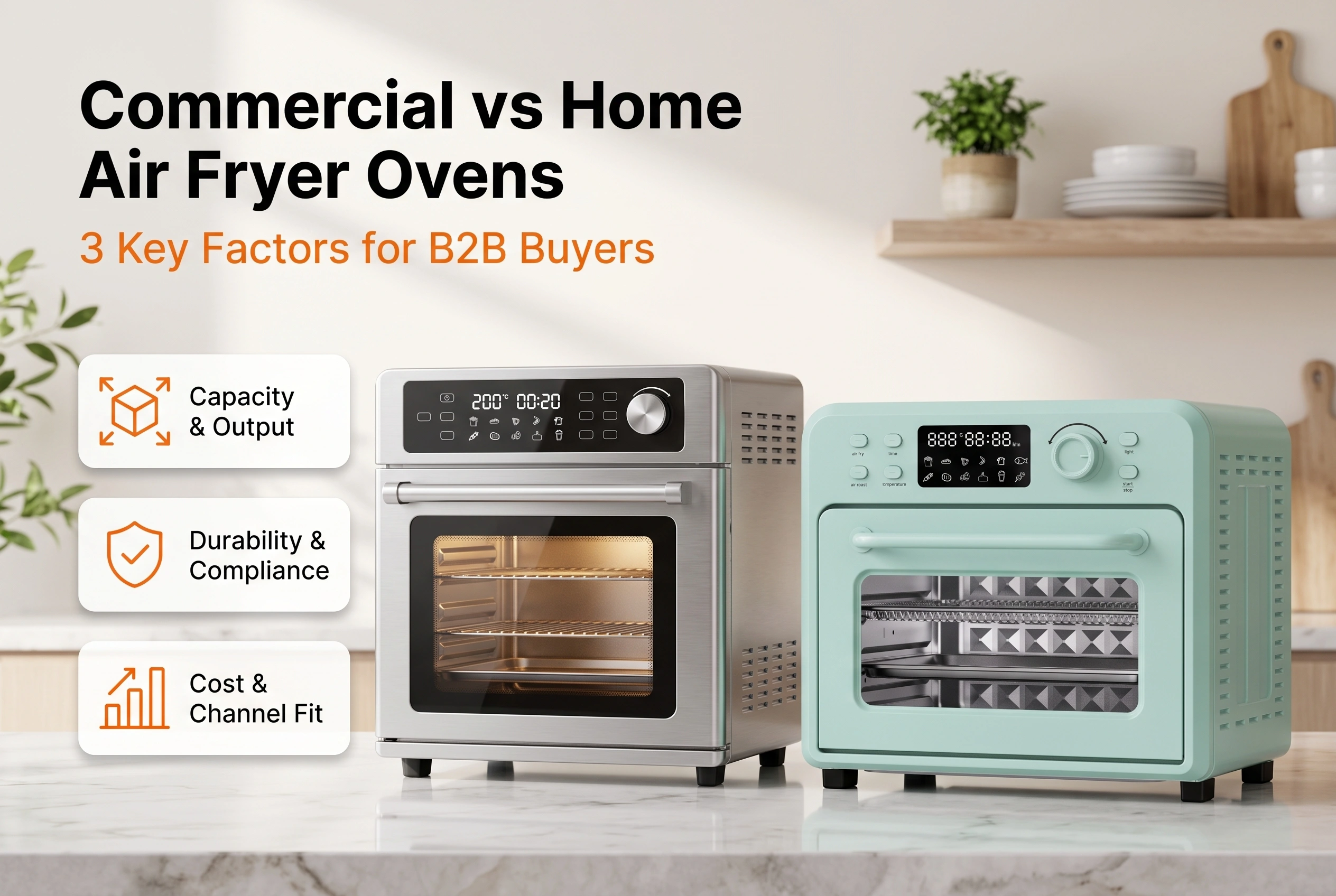
Table of Contents
1. Capacity: From “Cooking One Meal” to “Handling a Rush”
1.1 Nominal Capacity ≠ Usable Space
Household air fryers often have misleading capacity labels. A 5.8L home model may offer only about 196 cm² of effective loading area, fitting just 6–7 chicken wings per batch. In contrast, a true 14L commercial model provides up to 410 cm² of usable area, easily accommodating 22–24 wings at once.
Even more critical is the layout of usable space. To save countertop space, many home models use a vertical stacked design—but stacking creates cold zones of 20‑30% in the lower layers, resulting in uneven cooking across multiple tiers. Commercial ovens use a single‑layer tray design, completely eliminating this issue.
1.2 Heat Recovery: The Real Game‑Changer for Commercial Units
The core of capacity is not “how much fits in one go” but “how quickly it regains set temperature after loading.”
Real‑world test data shows:
- A 1700W home 5.8L model, when loaded with 500g of frozen fries, suffers a temperature drop of 68°C and takes 3.2 minutes to recover to 180°C.
- A 1800W commercial 14L model, under the same load, drops only 31°C and recovers in just 1.1 minutes.
The commercial unit uses lower wattage yet achieves 31% faster heat recovery.
What does this mean in practice? During peak lunch hours, a commercial air fryer can run batch after batch with virtually no waiting time between cycles; a home unit will force you to pause and let it “catch up,” cutting your throughput by half.
1.3 Continuous Operation Capability
Household air fryers are designed for intermittent use—cook a meal, then rest. Commercial models are engineered for continuous duty, maintaining full performance throughout the entire service period without degradation. This is a fundamental engineering difference, not something you can fix by simply using a larger basket.
2. Durability: Plastic vs. Stainless Steel – More Than Just Looks
2.1 Materials Define Lifespan
Step into any professional kitchen, and you will see almost all equipment made of stainless steel—and that is no coincidence.
Commercial air fryer ovens feature all‑stainless‑steel bodies and internal metal components, while household models rely heavily on plastic housings and lightweight parts. In a hot, humid, high‑use kitchen environment, plastics degrade, warp, and may even release harmful substances over time. Stainless steel, on the other hand, withstands dozens of door openings per day, high‑temperature cycling, and frequent cleaning without losing integrity.
2.2 The Hidden Cost of Cleaning and Maintenance
Commercial units are designed with removable, easy‑to‑clean interiors—smooth metal surfaces and detachable trays. Household models have more crevices and plastic parts where grease and food residues can become trapped. Over the long term, this makes cleaning more difficult and raises hygiene risks.
For foodservice operators, cleaning efficiency directly impacts labour costs and health inspection scores. A hard‑to‑clean device eats away at your profit margins every single day.
3. Certification Standards: The “Entry Ticket” for B2B Procurement
3.1 Safety Certifications Are a Hard Requirement
Household and commercial appliances follow entirely different certification regimes. B2B buyers must ensure that their suppliers hold internationally recognised certifications such as ISO 9001 (Quality Management), CE (Europe), UL or ETL (North America).
These are not optional “nice‑to‑haves”—they are mandatory for market access. In North America, ETL certification confirms that the product meets strict safety and performance standards; in Europe, CE marking is a legal requirement.
3.2 Hygiene Standards: Unique Demands for Commercial Kitchens
For foodservice procurement, NSF/ANSI 4 certification is especially critical. This is the sanitation standard for commercial cooking equipment, ensuring that the design and materials comply with food‑safety requirements.
A unit without NSF‑related certification may not even pass a health inspection. And household‑grade air fryers almost never meet these rigorous commercial hygiene standards.
4. Commercial vs. Household: At‑a‑Glance Comparison
| Aspect | Commercial‑Grade Air Fryer Oven | Household Model |
|---|---|---|
| Usage cycle | Continuous, all‑day operation | Intermittent, 1‑2 times per meal |
| Body material | Full stainless steel, metal internals | Plastic housing, lightweight parts |
| Batch capacity | Large, single‑layer tray design | Small, vertical stacking |
| Heat recovery time | Fast (1‑2 min) | Slow (3+ min) |
| Cooking uniformity | Minimal temperature variance, no flipping needed | Uneven heat, requires manual turning |
| Cleaning design | Smooth metal surfaces, easy disassembly | Multiple crevices, complex cleaning |
| Certifications | UL / ETL / CE / NSF | Basic safety certifications only |
5. Why Choose Linden: The Smart Choice for B2B Sourcing
Now that you understand the key differences between commercial and household models, the next question is: Who should you partner with?
For brands, distributors, and procurement professionals looking to enter the air fryer oven market, finding an OEM/ODM partner with both technical expertise and market insight is far more efficient than building a production line from scratch.
Foshan Linden Smart Appliance is exactly that kind of partner.
5.1 Full‑Spectrum OEM/ODM Capabilities
With over a decade of experience in kitchen appliance manufacturing, Linden operates three dedicated production lines focused on 12L, 16L, and 30L air fryer ovens. From product design and tooling development to mass production and delivery, Linden offers one‑stop customisation services that turn your brand vision into tangible products.
5.2 Low MOQ – Lowering the Barrier to Entry
For small‑ and medium‑sized brands or first‑time buyers, high minimum order quantities are often the biggest obstacle. Linden understands this and offers flexible MOQ options, allowing more B2B customers to start their projects at a reasonable cost.
5.3 Rapid Prototyping – Accelerating Time‑to‑Market
Market opportunities wait for no one. Linden’s efficient production processes support rapid prototyping, enabling clients to obtain physical samples for testing and validation during the development phase. This means you can bring your products to market faster and seize the competitive edge.
5.4 Certification Support – Direct Access to Global Markets
Linden’s products are designed with target‑market certification requirements in mind, and the company actively supports clients in obtaining CE, UL, ETL, and other international approvals. Whether you are targeting North America, Europe, the Middle East, or beyond, Linden can deliver solutions that meet local standards.
5.5 Engineering Excellence
Linden’s air fryer ovens feature high‑velocity airflow systems and precision temperature control, achieving accuracy within ±4°C to ±5°C. In terms of thermal uniformity, cooking efficiency, and long‑term durability, they meet true commercial‑grade standards.
Conclusion
The differences between a household air fryer and a commercial‑grade air fryer oven go far beyond “bigger and more expensive.” From throughput efficiency and material durability to certification requirements, every dimension points to the same conclusion: commercial scenarios demand commercial‑grade engineering, and domestic products cannot be simply “scaled up” to meet those needs.
For B2B buyers, choosing the right product and the right partner are equally critical. Linden Smart Appliance, with its mature OEM/ODM capabilities, flexible MOQs, rapid prototyping services, and comprehensive certification support, is committed to being a reliable partner for global B2B customers entering the air fryer oven market.
